

We are inherently interested in extremes. The largest and smallest usually catch our attention more than, say, the average. Among all the plant superlatives, it may be the tallest trees that evoke the most awe and persuade us to bequeath these behemoths with proper nouns. Among these individuals are Hyperion, a 380 ft tall Coastal Redwood (Sequoia sempervirens) and Centurion, a Eucalyptus regnans in Australia measuring 330 ft tall. Yet, there are some real challenges with being the tallest organisms on the planet.
This semester I have been teaching a new course at the University of Tennessee: Plant Anatomy and Physiology. We spent about four weeks discussing the intricacies of leaf and stem anatomy as they relate to water movement. So my mind has been wrapped up in this space. I joked with my students about the amount of time we spent on this topic, which usually gets just a week, or even a day, in other plant courses. In preparing and delivering my lectures I came to realize that the process of water movement in plants - or the ascent of sap as it was called by Martin H. Zimmermann - is extremely unintuitive. The overwhelming majority of educated people have not a single clue how it works. I find this important to reconcile, as sap flow is one of the most important biological phenomena on Earth. We can tie nearly all of the terrestrially-produced oxygen and sequestered CO2 directly to this process. In this essay, I would like to explain, as clearly as I can, how plants move water hundreds of feet into the air.
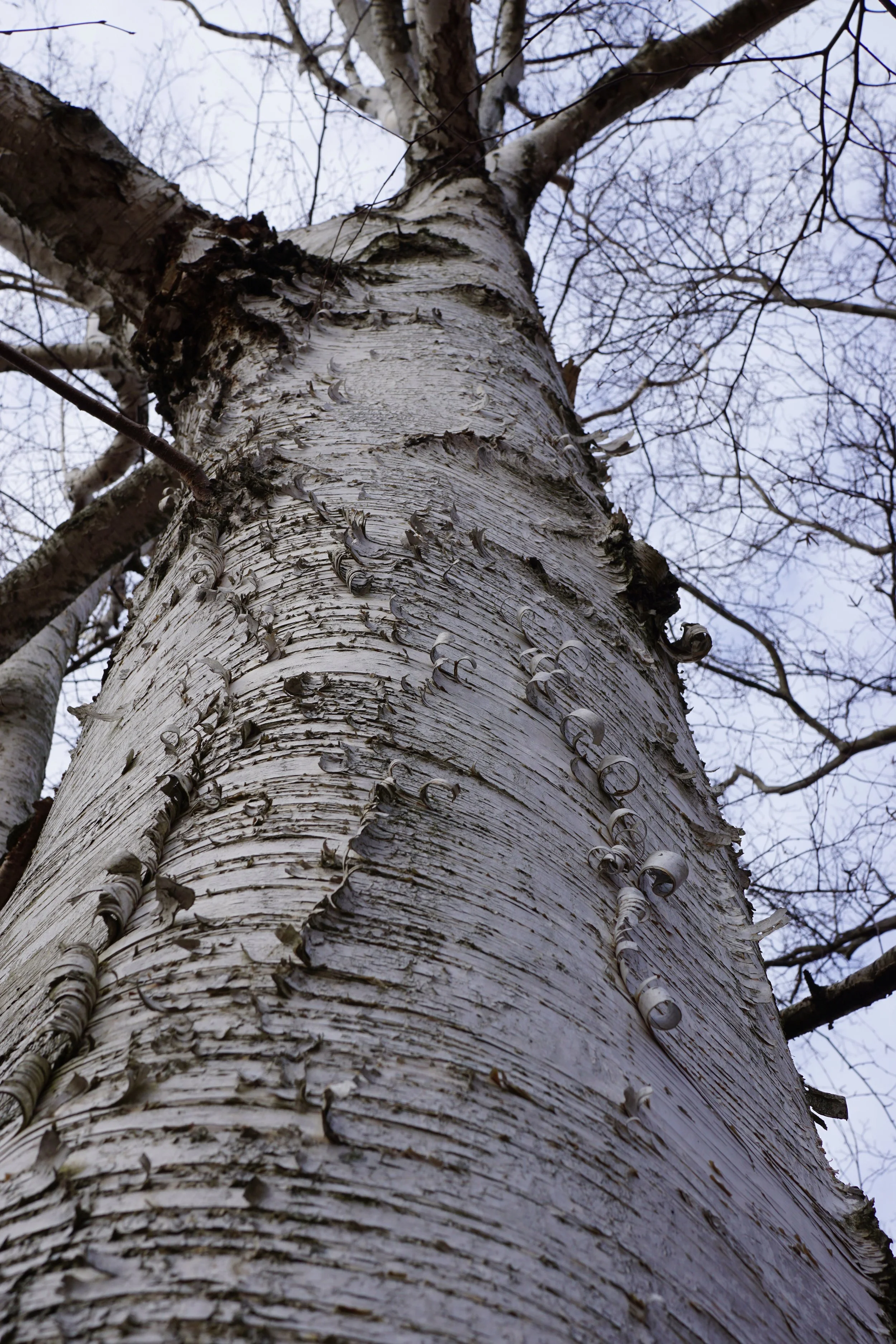
Not quite the tallest tree, but a staggering downy birch (Betula pubescens) in the Arnold Arboretum of Harvard University.
Every high school biology student is forced to remember the names of a plant’s vascular tissues: xylem and phloem. The xylem is the set of tissues that move water through the plant’s body, and the phloem is the sugar-conducting tissue. When learned as a static typological distinction, these tissues are not all that exciting. Yet, understanding how they are able to move water 400 ft into the air has the potential to inspire awe equal in stature to Centurion.
I will preemptively apologize for the forthcoming technicality, but I think it is important to understand the structure of the water conducting cells in order to discuss the actual mechanism of water movement. The bulk of a tree is xylem, secondary xylem (or wood) to be exact. The xylem tissue is composed of several different cell types, including cells specialized for storage (parenchyma) and for support (fibers). But the water conducting cells, tracheary elements, are by far the most abundant. There are two basic types of tracheary elements: tracheids and vessel elements. Tracheids are narrower and tapered, while vessel elements are wider, stout, and usually stacked on top of each other. The tracheary elements are beautifully adapted for moving large amounts of water through them. Each element is usually larger in diameter than other cells, spanning ~10µm to over 100µm in diameter - roughly the thickness of a human hair. Every high school biology course would also not be complete without a lesson plan on that fundamental difference between plant cells and animal cells: the cell wall. Every plant cell has one, but water conducting cells have an additional secondary cell wall that is structurally reinforced with a chemical compound called lignin. This secondary cell wall is not equally deposited around the entire cell. There are many places along the cell that lack a secondary wall, leaving small pits with little membranes that connect two adjacent tracheary elements. Vessel elements go a bit further, they have large regions at both ends of the cell where the secondary wall is not deposited; these are called perforation plates. Water can pass laterally through pits and vertically through perforation plates. Many vessel elements can stack directly on top of each other, forming a large single vessel inside of which water passes directly through perforation plates.

Compound bright field micrograph of tracheids in Abies concolor. Notice the simple pores on the lateral walls. Source: A.G. Heiss CC BY-SA 3.0
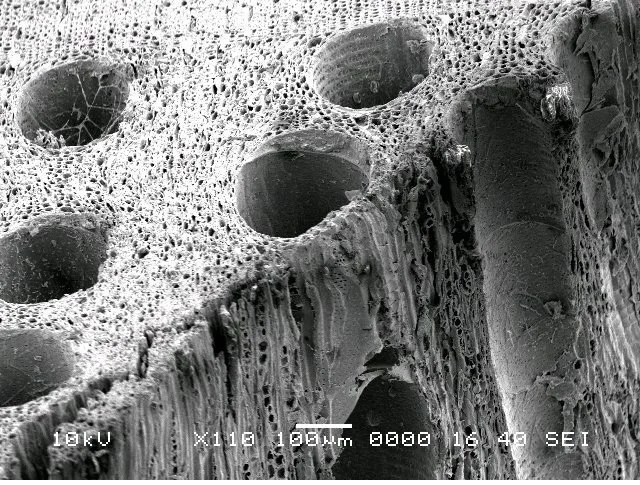
SEM micrograph of vessel elements showing wide open perforation plates at the top and stacked vessel elements forming a single large vessel to the right. Source: Mckdandy CC BY 2.5.
All tracheary elements, tracheids and vessel elements, are dead at maturity. That is perhaps an odd statement, but makes sense when we think about their function. Cells usually have a bunch of stuff in them: organelles, cytoplasm, enzymes, proteins, ribosomes, a nucleus and are surrounded by a plasma membrane. If you were designing a tube to move water through, you probably wouldn't also fill it with material. However, a cell can’t just develop without anything in it, so in order to get all these cellular contents out, they need to be actively removed. The way plants do this is by committing cellular suicide, also called autolysis. After tracheary elements build their secondary cell wall, they die. All of their internal contents are dissolved and they lose their plasma membrane. Since the secondary cell wall is impregnated with lignin, after the cell dies it leaves behind a husk made of this secondary cell wall. You can think of this as a hollow perforated PVC pipe. This network of tubes traverses the entire plant and connects the roots in the soil to the leaves in the canopy.
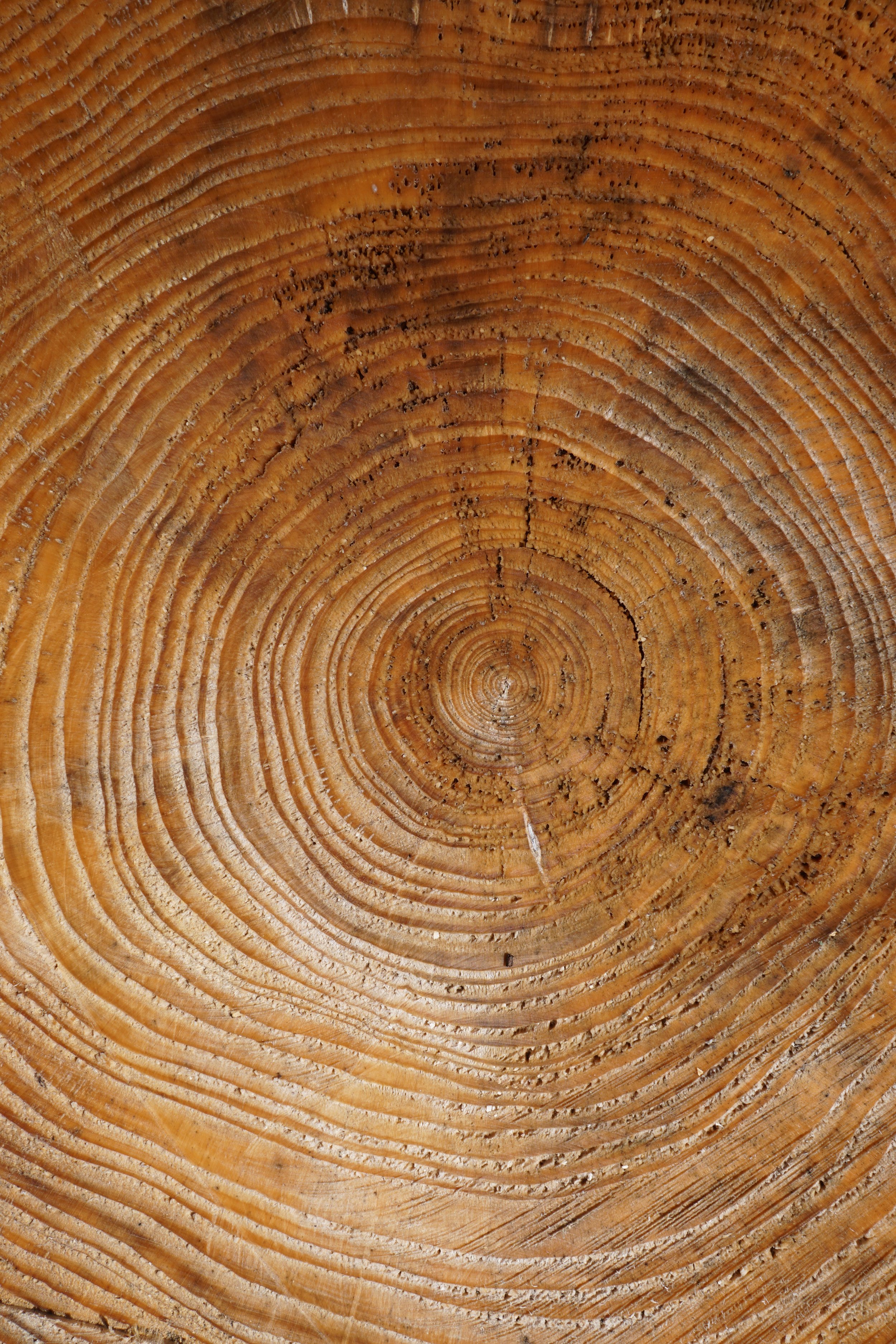
Growth rings in wood cross section.
To move water up to a 300-foot tall building would require an immense amount of energy. But, plants do this on a daily basis without using any energy at all. Instead, they take advantage of the intrinsic properties of water - the ability of each water molecule to stick to one another (cohesion) and to other surfaces (adhesion). Water is literally pulled up the plant through the tracheary elements. Within these tubes water is forming a column, like it does in a standard garden hose or straw. This occurs because at the molecular level each water molecule is cohesively sticking to an adjacent water molecule through hydrogen bonds - small forces that link the hydrogen of one H2O molecule to the oxygen of another - and to the lignified walls of the tubes through adhesive forces. However, that doesn’t explain the force that pulls water up a plant, against gravity.
The stomata (small pores in the leaves) open during the day to allow CO2 to enter the body for photosynthesis. As these pores open, water in the internal leaf spaces evaporates. When a single water molecule evaporates, it imparts tension on the surrounding water molecules thanks to the strong cohesive force. So, as each water molecule evaporates from the stomata it pulls on others which creates tension - pulling each water molecule up the xylem like links in a chain. The driving gradient for water movement in a plant is thus evaporation of water from the leaf itself. This is like drinking through a straw. The cohesive and adhesive forces of the water in your drink of choice would allow the liquid to stick to itself and the walls of the straw. The suction you create with your mouth on the straw acts as the driving force. When you suck through a straw, you lower the pressure inside the straw below atmospheric pressure, allowing the liquid to move up toward your mouth. But, you can only lower the pressure so far. Even a perfect vacuum (zero absolute pressure), which is more than we can create with our mouth, represents the theoretical limit. And interestingly, a perfect vacuum can only lift water roughly 30ft in the air. In a plant, the evaporative forces of water from the leaf create so much tension in the water column that it can exceed tension values of -3 megapascals or ~435 PSI, roughly 20 times the pressure that exists in a car tire! But remember, this is not positive pressure pushing water through the plant, as in an inflated tire. Rather, water is under tension and is being pulled upward through the xylem by the evaporative forces generated at the leaves.
There are, however, issues with moving water in this way. The water column is under tension relative to atmospheric pressure. Since the water molecules themselves have cohesive forces, the water column in the xylem is like a taut rope. And just like a taut rope, it can snap. As the temperature gets hotter, more water evaporates from the leaf surface. This means that the tension on the xylem water column increases - this is like pulling harder and harder on the rope. This is not that big of a problem if the plant has sufficient soil water. However, during a drought, soil water availability can become very low. As the tension in the xylem becomes greater, it can lead to a catastrophic rupturing of the water column whereby a water-filled water conducting cell becomes air filled. This is called an embolism and is the primary way plants die from acute drought stress. Once an air bubble expands from wall to wall, the continuous chain of water molecules from root to leaf is broken in this tube. If enough tubes fail, the plant cannot supply the water demands of its tissues. An important point here is that the cohesive forces in the water column itself don’t just rupture - that would occur at very low water potentials that are not usually experienced by plants. Rather, imperfections between the water column and the tracheary elements lead to the expansion of small air bubbles that are dissolved in the water - much like how bubbles in champagne emerge.
You may expect that different species have different tolerances to drought-induced embolism, and you’d be right. The usual trend is that plants which grow in drier areas tend to be more resistant to drought-induced embolism than those from wetter regions. Of the many traits that have been measured, the ones with the strongest correlation to drought-induced hydraulic failure are the area of the pits and the thickness of the pit membranes on the tracheary elements. Specifically, species with smaller pits and thicker pit membranes, as well as smaller water conducting cells in general, are generally more resistant to drought-induced embolism. Yet, there is a tradeoff. These safer plants are generally less efficient, they can’t move large amounts of water through their xylem. This is because the same traits that decrease the probability of drought-induced embolism, also dictate the total hydraulic conductance, so species with wider tracheary elements, thinner pit membranes, and larger pits have a high conductance. Thus, we see a tradeoff in plants between safety and conductance. But, according to Gleason et al., (2016) this is not exactly a simple tradeoff. While species can’t be both efficient and safe, there are many species that are not very safe but also not very efficient. This suggests that neither high safety nor high efficiency is always selected for in any environment. It is possible that in everwet tropical forests, for instance, there is selection for neither efficient nor safe xylem. If the selection pressure is not there, the traits will usually not evolve - assuming drift doesn't accidentally take it there.
An average oak tree can take up 110 gallons of water per day and ~40,000 gallons per year. However, they may only use 1% of that (400 gallons) in actual metabolism. So, what happens to the rest of this water? Most of it is simply lost to the environment out of the stomata. This means the plant pulls 100X more water from the soil to its leaves than it actually uses. Plants have evolved these elaborate strategies to pull water under such intense pressure only to lose the overwhelming majority of it through evaporation. This raises the question, why move this much water in the first place? The answer is: sugar.
In order to make sugar through the process of photosynthesis, plants need CO2. Most plants - with the exception of some weird aquatic plants - take up CO2 through their stomata, the same pores they lose water through. Plants need to keep their stomata open in order to take up CO2 and do photosynthesis, otherwise they would starve to death. The reason plants can’t just take up CO2 through their body is because there is no known naturally occurring polymer that is permeable to CO2 but impermeable to H2O. The reason for this chemical dilemma is that these two molecules are very similar, structurally speaking, and thus behave similarly. Most land plants are fully covered with a protective covering called a cuticle, which is composed of hydrophobic waxy polymers. If plants were not covered with this wax, they would simply lose too much water and dry up - or at least be in equilibrium with the humidity and water status of their surrounding habitat (which is what most moss do).
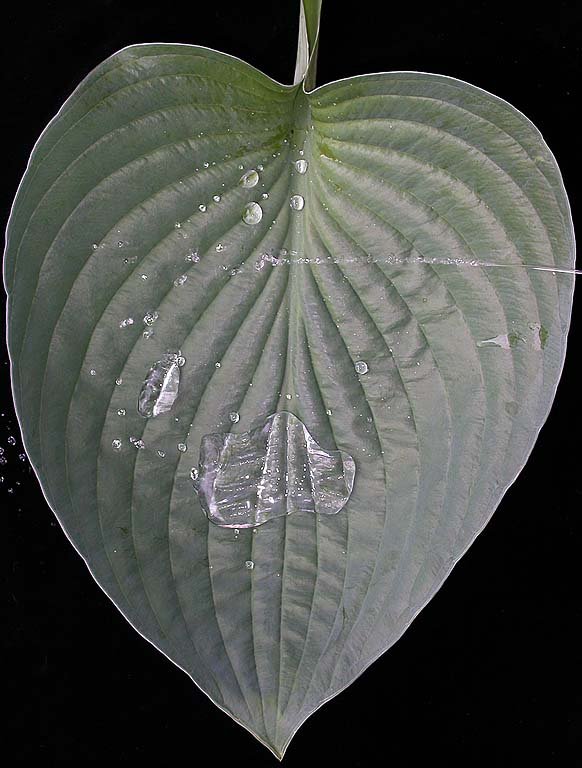
Waxy surface on a host leaf. Source: Plantsurfer CC BY 2.5.
Plants didn't have to deal with desiccation when they were fully aquatic organisms, 470 million years ago. They only evolved this cuticle as an adaptation to drying environments as they colonized land. In a sense, as plants evolved the cuticle to survive desiccation on dry land, they created additional self-induced selection pressures. As the cuticle evolved it then necessitated additional mechanisms of gas exchange - so, stomata became the primary trait to facilitate that trade. But, these holes in the cuticle also led to the loss of large amounts of water, which then facilitated a mechanism of bulk water movement, thus tracheary elements. The dynamic between stomatal opening, CO2 uptake, and water loss is sometimes described as an unavoidable evil. Since plants need to take up CO2, they open their stomata, in the process losing gallons of unused water. It may be an evil through the lens of the plant, but it has profound consequences for the terrestrial ecosystem.
There is no free lunch in life, and everything requires a tradeoff. If only there was a natural polymer permeable to CO2, but not water, plants may function very differently.
Further readings and references:
Gleason, Sean M., et al. "Weak tradeoff between xylem safety and xylem‐specific hydraulic efficiency across the world's woody plant species." New Phytologist 209.1 (2016): 123-136.
Taiz, Lincoln, Eduardo Zeiger, Ian M. Møller, and Angus Murphy. Plant Physiology and Development. 6th ed., Sinauer Associates, 2015.
Tyree, Melvin T., and Martin H. Zimmermann. Xylem structure and the ascent of sap. Springer Science & Business Media, 2002.
Venturas, Martin D., John S. Sperry, and Uwe G. Hacke. "Plant xylem hydraulics: what we understand, current research, and future challenges." Journal of integrative plant biology 59.6 (2017): 356-389.
Edited by Ben Goulet-Scott