

The Cranefly’s Freckles
Fall in the temperate region is a lovely time to botanize. The crispness cleans the air and reds, browns, and yellows warm the landscape. This is a time when plants are preparing themselves for the winter, removing all the nutrients they can from their leaves, dispersing their final fruits, and slowing down metabolism. However, some species are just awakening.
The Cranefly orchid, Tipularia discolor, is one such species. This plant grows from Florida to Vermont and as far west as Missouri. In the Fall when the rest of the forest is slowing down, T. discolor puts out its first and only leaf of the season. It will photosynthesize during the fall and winter, storing all the nutrients it needs for the year in a below ground storage organ called a corm—a potato-like structure. As soon as spring rolls around and the forest begins to awaken again, its leaves senesce. After a short hiatus during the spring senescence T. discolor will flower in midsummer and produce fruit into October. This strategy of winter leafing-out is called a wintergreen phenology.
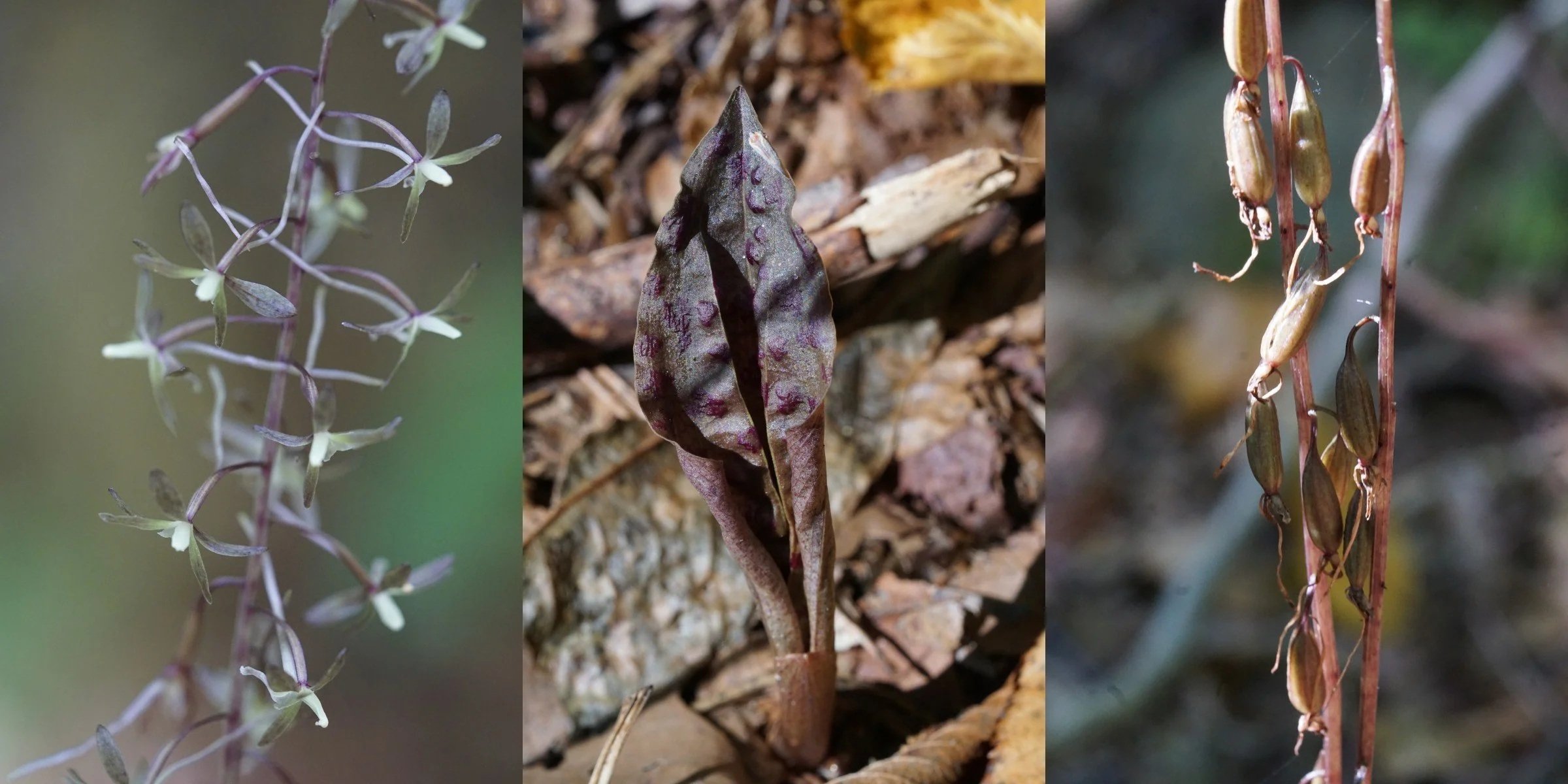
Tipularia discolor flowers in August, while the fruits develop and leaves emerge in September.
It is somewhat ironic to call this species wintergreen, because the leaves are often not exclusively green. Depending on the individual you stumble upon, some leaves will have purple undersides and a greenish surface, others will be green with blackish-purple spots that look like freckles, and still others may appear entirely black. The dark colors are produced by pigment molecules called anthocyanins that are actually red. With enough of these molecules, tissues can appear black. The specific chemical composition of anthocyanin molecules is quite diverse and according to research by Nicole Hughes out of High Point University, the Cranefly orchid along with other members of the Orchidaceae family, produce a unique class of anthocyanins with a special arrangement of sugar molecules in a 3,7,3′ linkage. This just means the sugar molecules on the anthocyanins are arranged in a specific, and relatively unique, way.
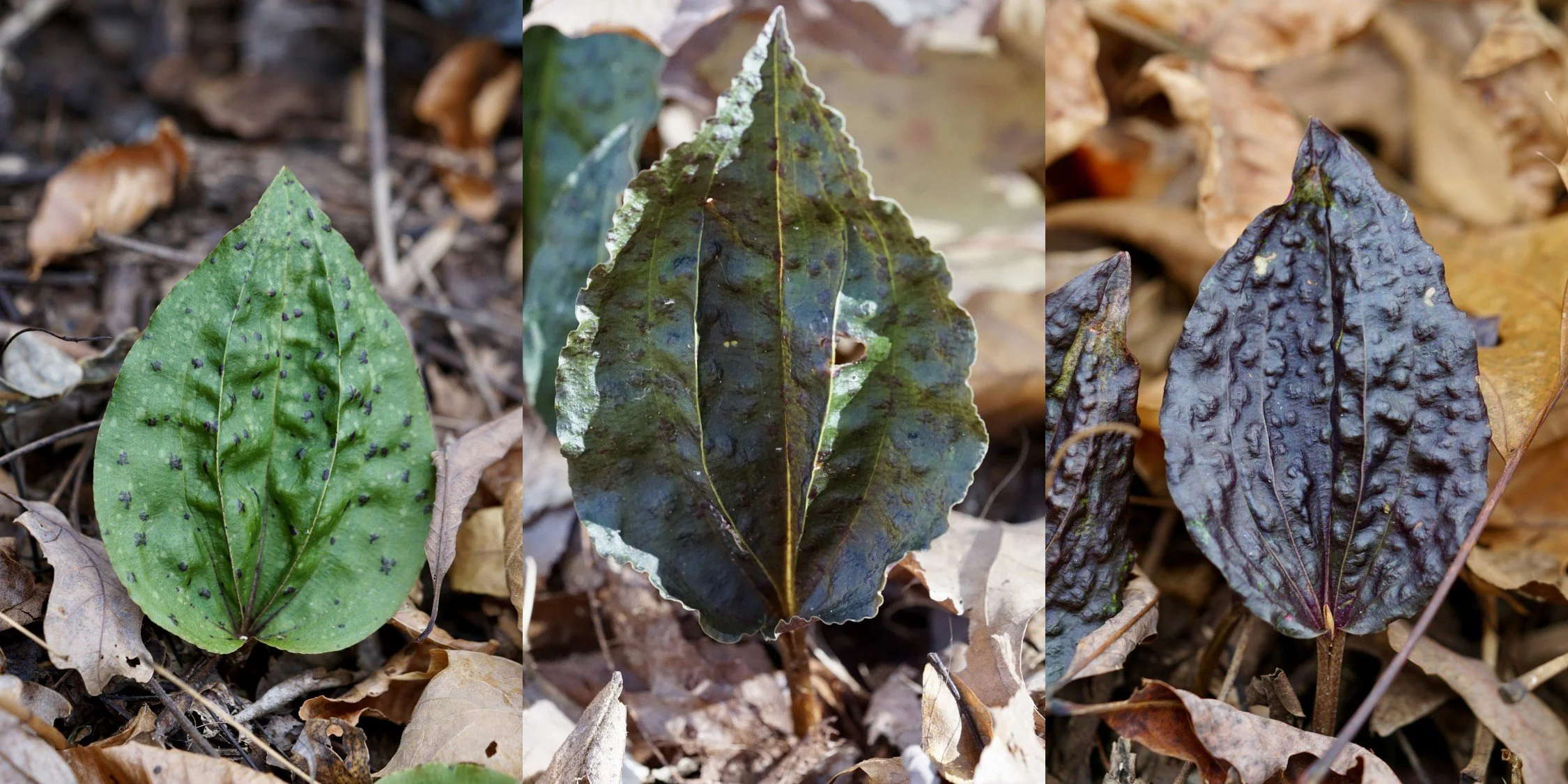
Different leaf color morphs of Tipularia discolor.
The drastically different colors of greens, blacks, and speckles of the Cranefly orchid have always caught my eye. There are many understory herbs that produce evergreen leaves which turn red in the winter. For instance, some species like little brown jug (Hexastylis brevifolia), common ivy (Hedera helix), or even the cut-leaf grape fern (Sceptridium dissectum) can upregulate anthocyanin production in the winter, turning a single green leaf red. This change occurs each year depending on temperature and sunlight. Indeed, once I stumbled upon a cut-leaf grape fern where one leaflet overlapped another. The part of the leaf that was exposed to the sun was red, while the covered leaflet was green.
In many understory herbs the production of red anthocyanins in winter is plastic, meaning it can be turned off or turned on to varying degrees depending on the external conditions. These red pigments are hypothesized to be photoprotective, acting like a sunscreen and being upregulated during periods of excess sunlight. They may also help reduce herbivory, functioning as a sort of botanical camouflage. However, in the Cranefly orchid, these color patterns are consistent within an individual, regardless of the habitat they grow in. Hughes and colleagues cultivated individuals from the field in a common garden and individuals produced leaves that were consistently the same color, regardless of their light levels. This consistency of color within an individual across environments means that the differences between black, speckled, and green leaves are likely genetic.
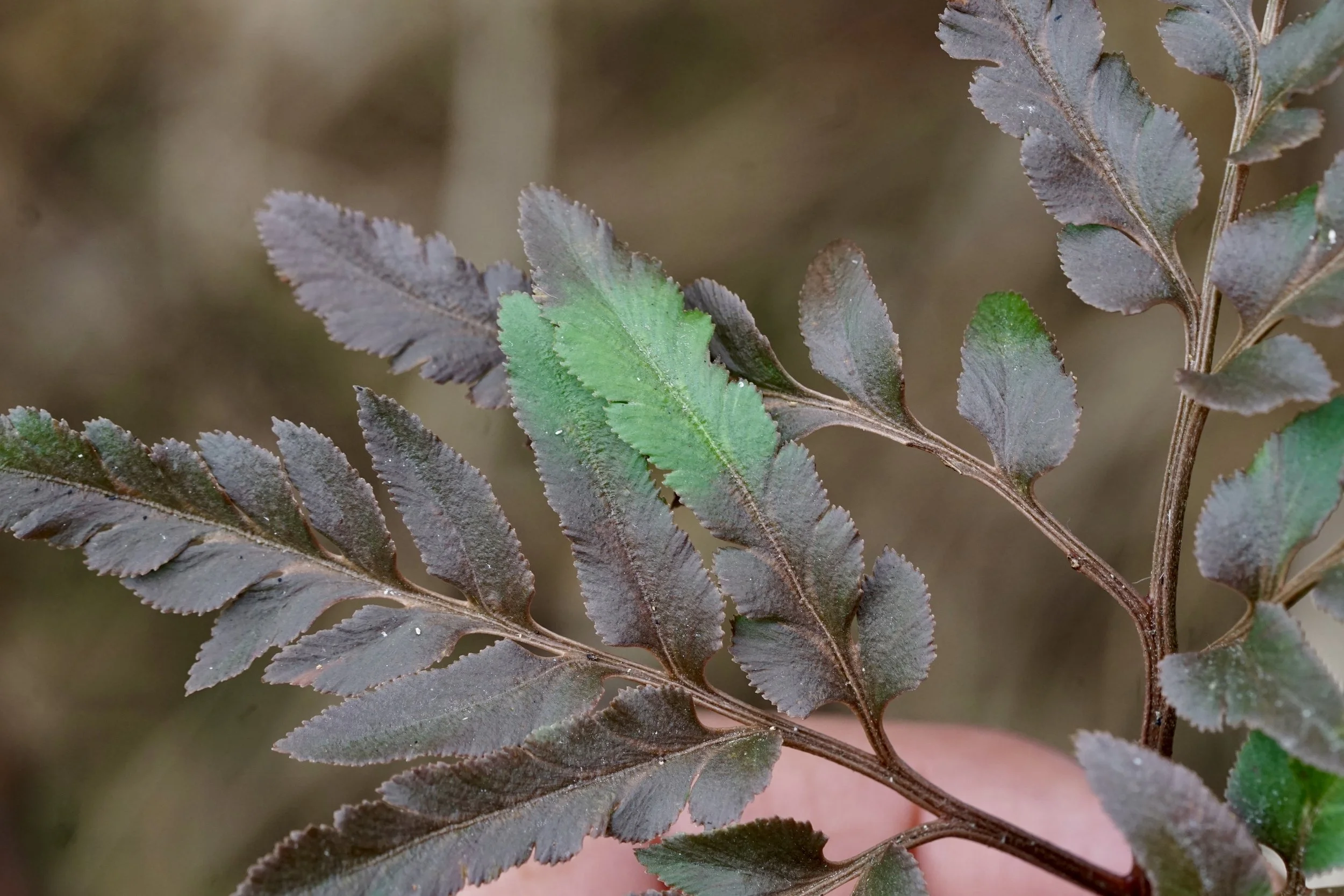
The red pigments in Sceptridium dissectum are inducible in the winter sun. Note the green portion of the leaf was shaded by another leaflet.
From a broader evolutionary perspective, when a trait is variable within a population and has a genetic basis it provides a great system to ask about adaptation. Indeed, these are some of the pillars of natural selection (a trait must be variable in the population and heritable).
Given these patterns of genetic determination of color variation in the Cranefly orchid, we may expect that one type of leaf color should confer greater fitness than others. Since one hypothesis for these winter colors is photoprotection, it is logical to hypothesize that these pigments may affect the aspects of photosynthesis. However, Hughes and colleagues did not find any difference in photosynthetic ability across leaf types of the Cranefly orchid. Rather, they propose that these different leaf colors represent a trait that may be shaped by herbivory. The idea here is that these leaves are up all winter and many herbivores are looking for a winter snack. Different combinations of green, spotted, and black may be defensive, acting to camouflage the leaves from wandering herbivores. This is a fair hypothesis rooted in a sound theory, but the work has not yet been done to test this.
Interestingly, these leaf color patterns are quite common in Orchids. In fact they have some of the most colorful leaves in the botanical world. Kew Garden’s Orchid expert André Schuiteman published a beautiful bit of natural history on orchids in the journal Rheedea. Schuiteman opened his article with the following statements, “Orchids are best known for the extraordinary diversity of their flowers. It is fair to say that this has overshadowed the hardly less remarkable diversity of their vegetative parts.” Don’t let their flowers capture all of your attention, the leaves are gorgeous too. Schuiteman documented over 800 species in 101 genera of orchids that have leaf coloration. Given that 79% of orchids with leaf colors are terrestrial, the most common hypothesis for these colors is defense against large terrestrial herbivores. Indeed, in some of Schuiteman’s figures I could barely make out what was leaf and what was forest floor. This type of leaf color deception is often called “defensive colouration” and can fall into one of three categories: camouflage, mimicry, or aposematic coloration. Poking fun at the difference between camouflage and mimicry, Schuiteman says, “The distinction between camouflage and mimicry is not always clear cut… One would almost have to be able to question an actual herbivore. Would the answer be: “I saw it, but I don’t like to eat dead leaves and dry twigs,” or would it be, “I didn’t see it”?” Aposematic coloration, on the other hand, is the process of “warning” herbivores that the leaf may be toxic. This is much more difficult to discern and has rarely, if ever, been validated in orchids. In orchids at least, it seems that most leaf coloration falls into the mimicry/camouflage bins.
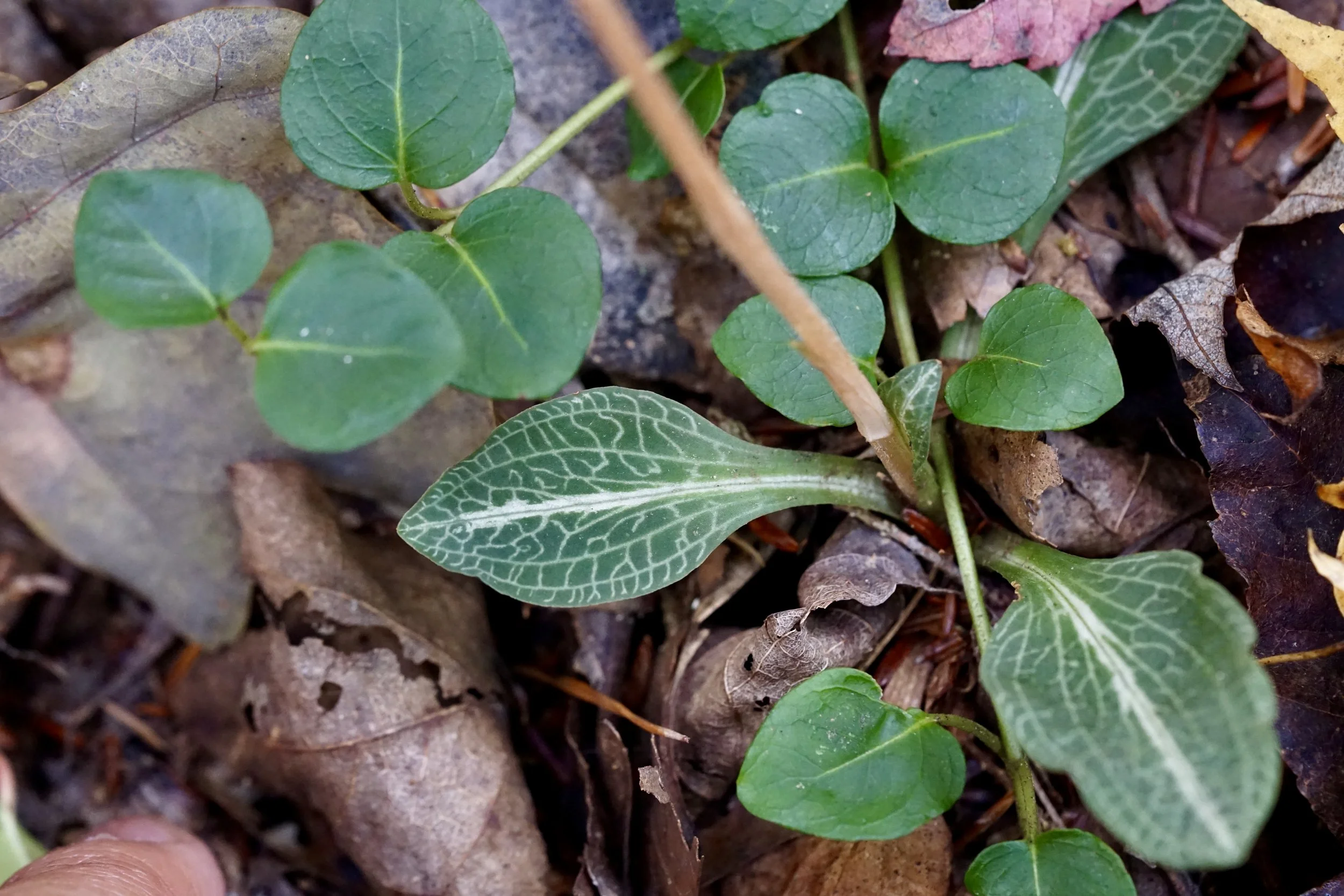
Deceptive coloration on a leaf one of the rattlesnake plantain orchids in the genus Goodyera.
Anthocyanin production is likely costly for the plant (e.g., it takes energy and nutrients to make them), so superfluous production of these pigments is unlikely to be maintained by selection. If these pigments are adaptive, it leads to an interesting evolutionary scenario. Usually studies of evolution are historical in nature. The trait of interest may be fixed, like the presence of tusks on an elephant, and we are looking back in the past to ask how these adaptations evolved.
But, based on the definition of an adaptation, there had to be a point in time where the population of organisms was variable in that trait. For instance, in the elephant example, there was a time point when the lineage that eventually became the elephant did not have tusks. There was another time point when some individuals in the population had tusk-like structures and others did not. If we went back in time to that exact point, we would see a situation similar to our Cranefly orchids—a mixed population where each individual is slightly different in the presence or absence (or size) of tusks.
What, then, would happen if we measured fitness of these individuals? How much would having a small tusk benefit the individual compared to another elephant without tusks? Clearly, based on the evolutionary outcome, having tusks conferred a fitness advantage. However, we would see a mixed population and ask if tusks are “beneficial” why do we see a variable population?
The answer is time and strength of selection. It often takes time for traits to evolve. It is possible that traits can change in one fell swoop, for instance mass extinctions can wipe out entire lineages, let alone individuals in a population. But, under moderate selection pressures, a long time is necessary. In his Scientific American article entitled Origin of life the American chemist George Wald said, “Time is the hero of the plot … Given so much time, the impossible becomes possible, the possible becomes probable, the probable becomes virtually certain.”
In the Cranefly orchid, it may be the case that black or spotted leaves confer an increased advantage to herbivory in overwintering leaves. It may also be the case that the fitness advantage conferred by the Cranefly’s freckles is quite low and populations are large, meaning it will take time for these traits to become fixed in a population (all other things being equal). The time it takes for an adaptive trait to become fixed in the population relies on the relative size of the population and the strength of selection. In many cases, we are talking about time in the range of 10's to 100's of thousands of years, if not millions. So, in large populations beneficial traits will take longer to become fixed in the population relative to a smaller population, but the probability that it will become fixed is greater.
There is another, maybe more likely, possibility as to why this color trait is variable in T. discolor. It could be that neither one of these leaf colors is, alone, adaptive. Rather there may be “negative frequency dependent selection”, meaning the fitness of any particular trait will decrease as it increases in frequency. It may be the case that whenever any one leaf color becomes very abundant in the population it tends to get preyed upon more by herbivores, eventually lowering the fitness of that color morph. Then, another color will rise in frequency and the cycle continues. This type of negative frequency dependent selection can maintain variation in the population without a strict direction to one optimal trait. Indeed, barring a good fossil record, we only ever get to see a population in a single evolutionary time point. If variable for a particular trait, what is the fate of this population? Will it continue on a trajectory towards one dominant trait, or stable variation? These are testable questions, and ones that evolutionary biologists are often asking. But, when we see a population it is ephemeral. At any given time we are at a beautifully perfect moment where evolution is unfolding right before our eyes.
References and further reading
Hughes, Nicole M., et al. "Photosynthetic profiles of green, purple, and spotted-leaf morphotypes of Tipularia discolor (Orchidaceae)." Southeastern Naturalist 18.4 (2019): 641-658.
Hughes, Nicole M., et al. "The same anthocyanins served four different ways: Insights into anthocyanin structure-function relationships from the wintergreen orchid, Tipularia discolor." Plant Science 303 (2021): 110793.
Hughes, Nicole M., et al. "The same anthocyanins served four different ways: Insights into anthocyanin structure-function relationships from the wintergreen orchid, Tipularia discolor." Plant Science 303 (2021): 110793.
Marchin, Renée M., Robert R. Dunn, and William A. Hoffmann. "Are winter-active species vulnerable to climate warming? A case study with the wintergreen terrestrial orchid, Tipularia discolor." Oecologia 176.4 (2014): 1161-1172.
Schuiteman, A. "Leopard spots, chequerboards and spider’s webs: classification, systematics and function of variegated leaves in Orchidaceae." Rheedea 31 (2021): 105.