

Blind Watchmakers, Panda’s Thumbs, and Sarcopera’s Red Cups
From William Paley’s 19th century Natural Theology to more modern explanations of the bombardier beetle’s complex defense mechanism, the apparent “perfection” of organismal adaptation is often used as an example of divine creation. The argument poses the question: how could such perfect adaptations arise from random processes? This idea is most artfully—although teleologically—articulated with the analogy of the blind watchmaker. If you stumbled upon a perfectly functioning watch in the woods, what is the probability that it randomly came into existence from scraps of metal? This analogy is made famous in Richard Dawkins’ The Blind Watchmaker (1986).
Paley’s watchmaker logic is flawed primarily because natural selection is not exactly random in this capacity. Rather, adaptation is best thought of as a ratcheted process, whereby good forms beget good forms in a systematic and cumulative way. Barring any major shifts in the landscape, traits that are adaptive and increase the reproductive output of an individual will become more common in the population. To give a botanical example, if a mutation arises that leads to larger prickles on a rose plant, those mutated individuals will be better defended, and suffer less herbivory. With less herbivore damage and more functioning leaf tissue, they will photosynthesize more, grow larger, and invest more in flowers and seeds. Thus, the probability of these large prickled mutants producing more offspring is greater than those with small prickles. Plants with large-prickle mutations, then, will become more common in the population over time.
Now, the offspring of these mutant roses do not start from scratch. Rather they inherit the newly adaptive larger prickles from their parents. A form of evolutionary privilege, if you will. Then, if an additional adaptive mutation occurred that made the prickles sharper, the cycle would continue anew with both larger and sharper prickles. These new cumulative modifications will be passed on. So on and so forth, as the structure appears more and more locally adapted to the environment in which it occurs. This is the compounding process of cumulative selection.
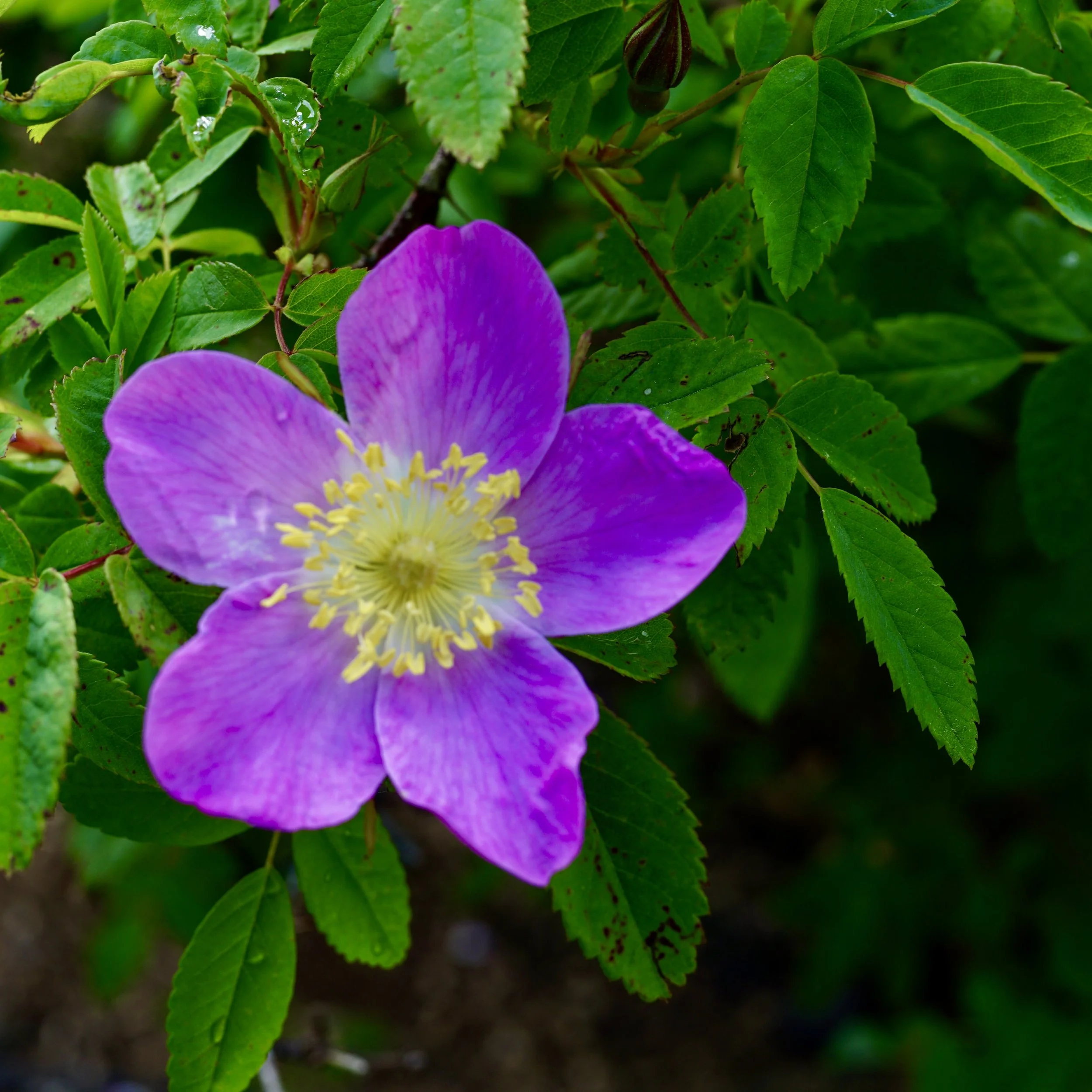
A rose flower armed with sharp prickles along the stem.
In The Blind Watchmaker, Dawkins uses the analogy of a monkey typing Shakespeare to highlight the difference between a random and cumulative process. If you had one million monkeys smashing on a keyboard—or a single monkey for one million years—the likelihood that the monkeys would type out all of Shakespeare is vanishingly low. Even if you take a single sentence from any play (Dawkins’ uses “Methinks it is like a weasel” from Hamlet) and calculate the probability that a monkey smashing a keyboard would write this sentence, it would be “1 in 10,000 million million million million million million.” Not statistically impossible, but incredibly unlikely, just like the probability of stumbling upon a fully formed watch that was crafted from random assemblages of metals.
However, you could imagine creating a system or an algorithm whereby every time the monkey typed a string of letters that happened to be close to the proper spelling of a word in the desired sentence, that text was kept and used as the foundation in the next iteration of the experiment. If this occurred continuously then the probability of a monkey typing a sentence from Shakespeare becomes much greater. Dawkins actually created a computer simulation that mimicked this process and was able to recover the desired phrase in roughly 40 iterations of keyboard smashing. This is the idea of natural selection, or more specifically, cumulative natural selection. Evolution does not strive towards an end goal, but in local and short-term conditions (millions of years sometimes), traits that increase an individual’s fitness will be continuously selected for over each successive generation.
While there are many beautiful and seemingly perfect adaptations, there are also many traits that just seem somewhat odd. They may very well be good adaptations, but just not in the right way based on our human imagination of how we might design something. One example highlighted by Stephen Jay Gould in The Panda’s Thumb (1980) is… the panda’s thumb. This thumb is an adaptation that pandas have evolved for peeling the sheaths off of bamboo shoots before eating them. However, there is one problem. This “thumb” is not actually a thumb. If you look carefully at a panda’s paw they have five digits (like all other bears). The “thumb” is actually a pseudodigit, a sixth structure modified from the wrist bone itself. The true thumb is actually similar to the thumbs of other bears and is more like a normal digit. Indeed, most other bears only have five fingers, in terms of true digits—the panda is no different. So, over evolutionary time, modifications of the wrist bone led to the odd pseudothumb that pandas use so elegantly to eat and survive.
If organisms were created, why would the panda’s digit that superficially resembles a thumb, not be a bona fide thumb? It does not seem like an elegant solution. If you were tasked with the goal of crafting an organism that uses its thumb to eat (and that organism had five digits), wouldn't the simplest, and perhaps most crafty option be to modify the existing thumb?
These are the quirks and mishaps of evolution. The messiness and untidiness of life that reveals to us the process of repeatedly favoring the best available improvements among a set of randomly generated options. Gould wrote, “Nature discloses the secrets of her past with the greatest reluctance” (Ever Since Darwin, 1977). But, when she does disclose them, it often provides deep insights into the unfolding of evolution. The point of this essay is to explain that evolution is perhaps better revealed through the chaos and ridiculousness of particular traits, rather than those adaptations that seem to be perfect.
When I was in Ecuador collecting plants with my colleagues, we stumbled upon a beautiful Sarcopera anomala. This species is a member of the Marcgraviaceae, a mostly neotropical lineage of shrubs, vines, and small trees. Some members of the family are common in the horticultural trade, where juvenile forms of species like Marcgravia umbellata are sold as climbing plants. One fascinating shared characteristic of the family is their whopping nectary—the structures that secrete nectar.
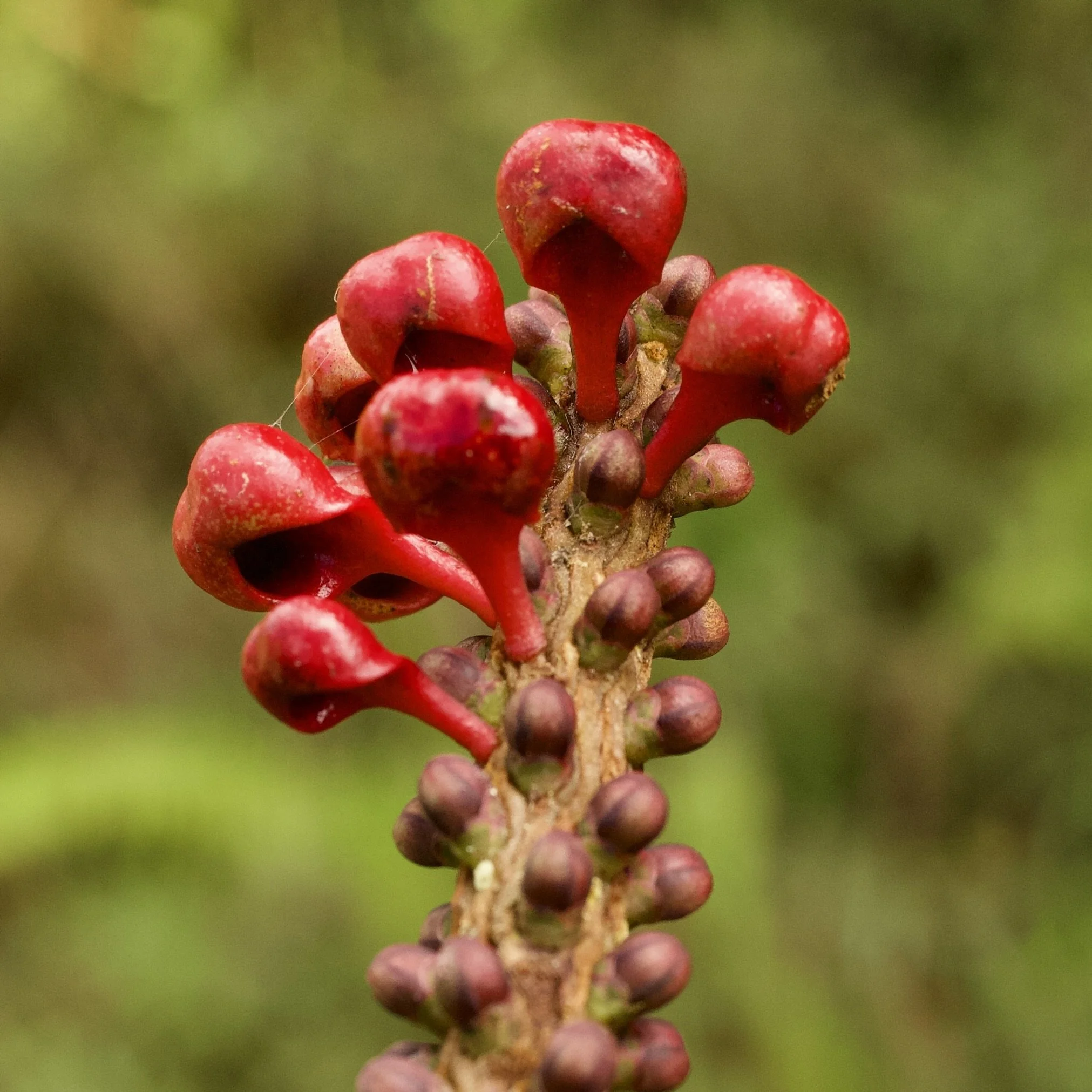
Sarcopera anomala red cup nectaries.
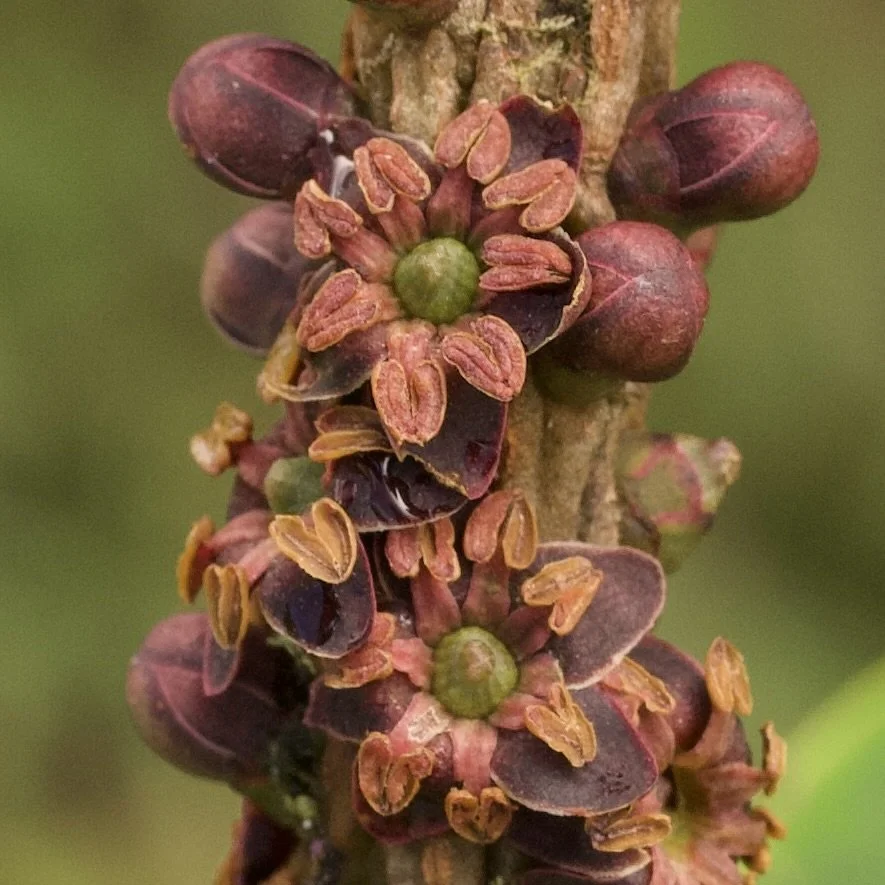
Sarcopera anomala flowers.
When most flowering plants produce nectar they do so as an evolved strategy to attract pollinators. Thus, most nectaries develop within the flower. This seems quite obvious of an adaptation and makes sense to our human brains—if you want an animal to get dusted with pollen and deposit it to another flower, put their reward inside the flower, duh.
However, Sarcopera anomala, and all other Marcgraviaceae, evolved in a different way. Instead of producing floral nectaries, they produce massive, alien-looking, blood-red, cups that are not part of the flower, but sit outside of the flower. The evolutionary origin of these red cups can be deduced from their position, development, and anatomy. Tellingly, they develop just below a flower, are physically attached to the branch by small stalks, and they occur in consistent geometric patterns along the branch known as Fibonacci series. This implies that they are actually highly modified leaves. These red-cup nectaries have little glands that secrete sugary sap into their crevices. This nectar is slurped up by birds and other animals including bats and the kinkajou (Potos flavus), an adorable mammal native to South America with a comically long tongue. When they visit the plants to drink nectar they may also move pollen between the flowers.
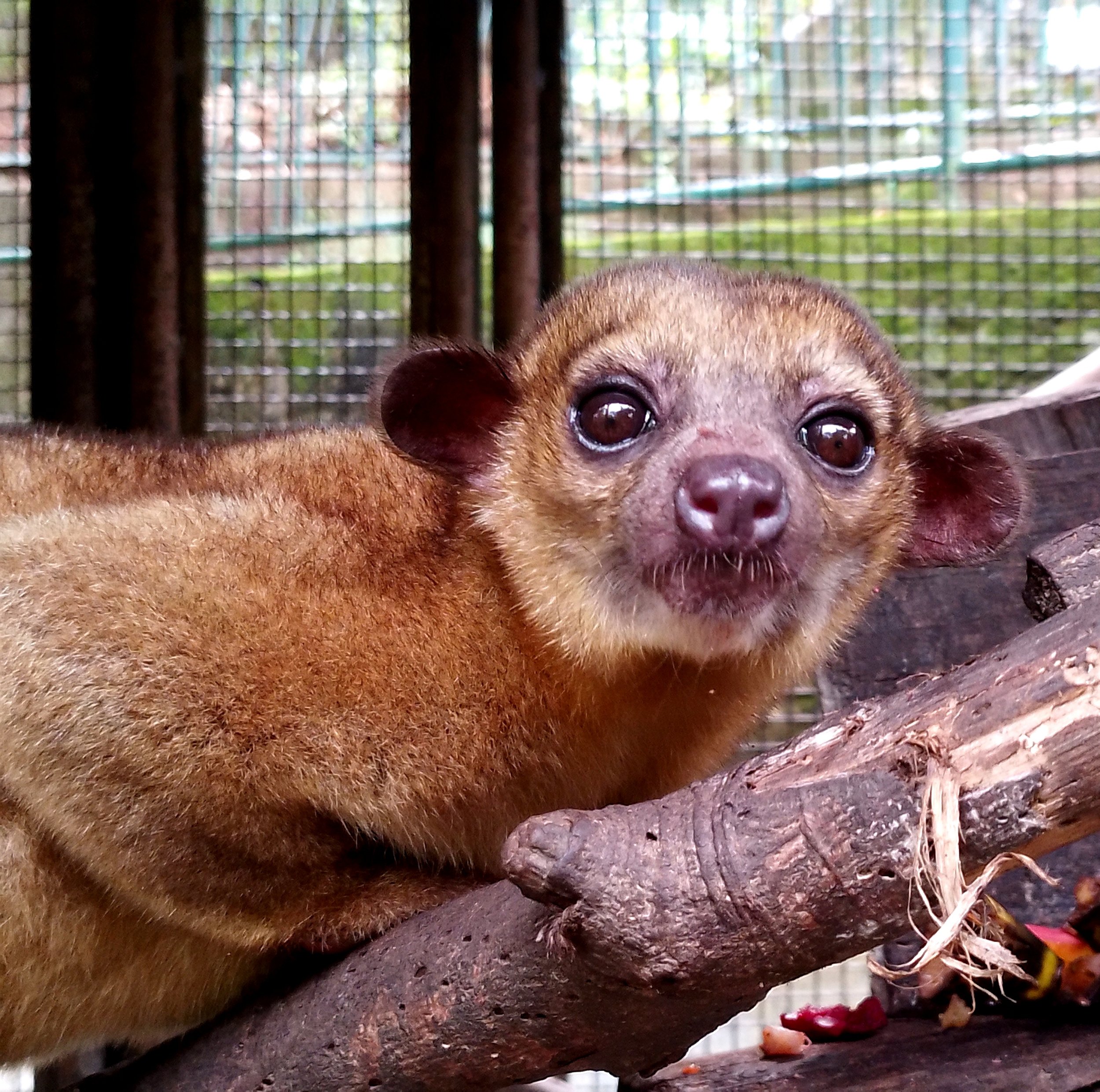
The comical kinkajou, which sometimes pollinates Sarcopera.
Image used under Creative Commons CC0 1.0 Universal Public Domain Dedication.
But how did these leaves evolve into nectaries? While the exact evolutionary steps from true leaves to these red nectary cups is unknown, we can propose one possible order of events. An interesting aspect of the leaves in species of Marcgraviaceae is that they produce small glands along the length of the midrib that often secrete sap. Moreover, across all plants, flowers are often subtended by some sort of leaf structure; these are often much smaller than normal leaves and called bracts. Since all Marcgraviaceae already have glands on their “normal” leaves, it is likely that the hypothetical bracts that may have once subtended the flowers also secreted some sort of sap. The first step in the evolution of the red cup nectaries could have been a mutation that made these bracts slightly enrolled or revolute (a common feature for the leaves of many plants). Indeed, if you look closely at some of the vegetative leaves of this species you can see small folds towards the base.
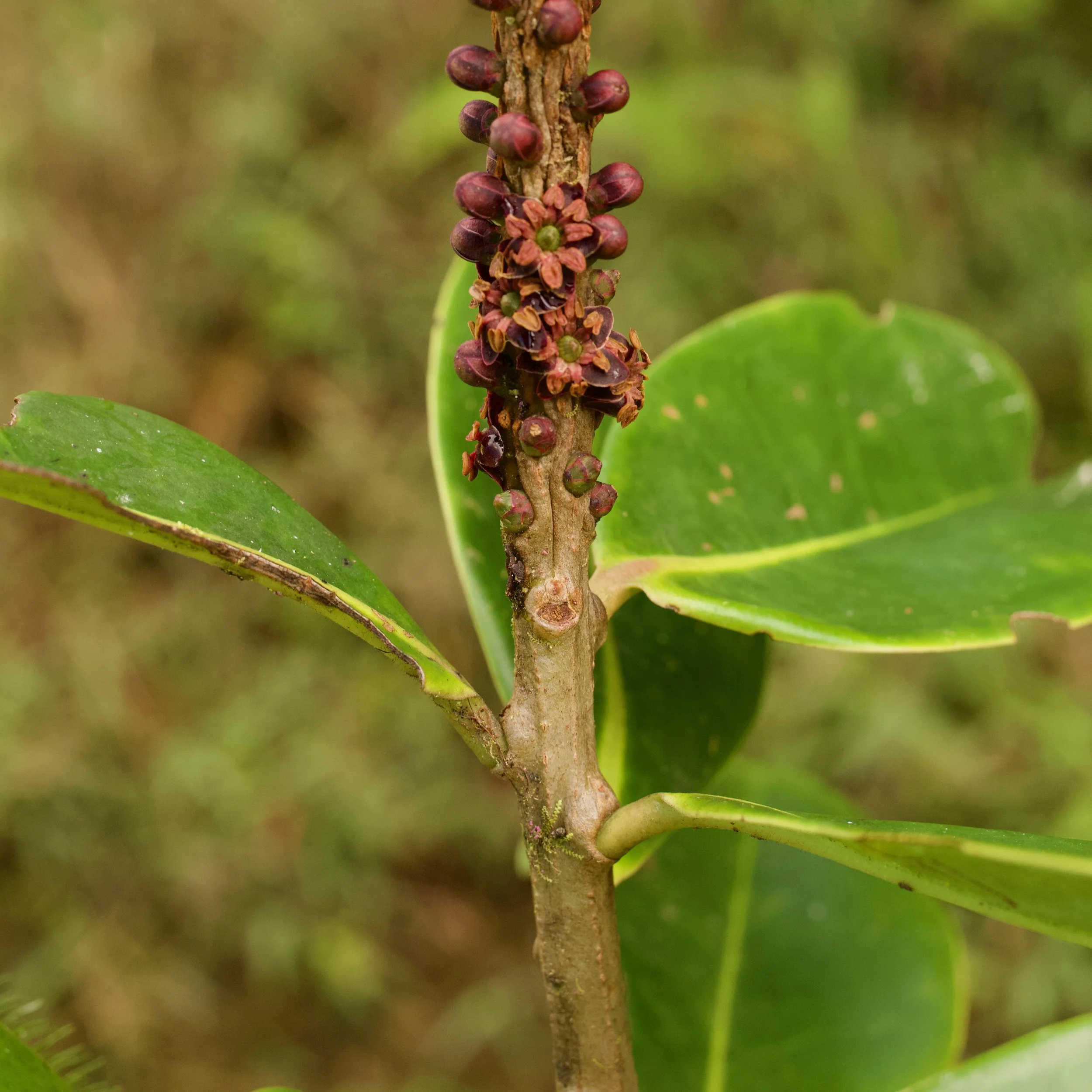
Base of inflorescence of S. anomala. Take a close look at the base of the leaf and you can see a slightly revolute margin.
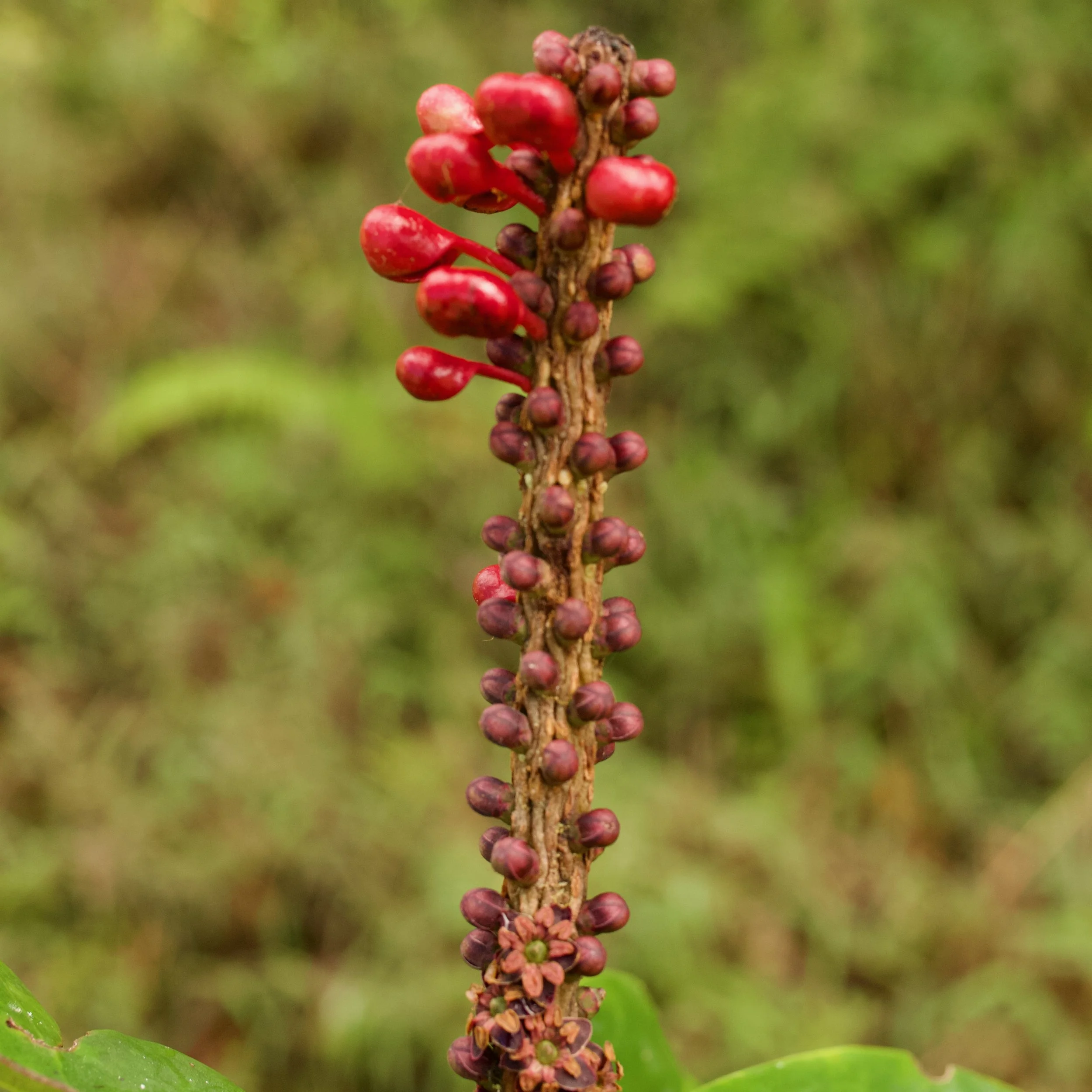
Inflorescence of Sarcopera anomala. The nectaries are arranged in a predictable geometric pattern along the stem.
Over time, these revolute margins could have collected sap along their edges. Those individuals then would have been visited more frequently by animals, thus increasing the probability of pollination and seed production. Thus, over time these mutated plants with revolute margins would be more abundant in the population. Later mutations that led to further invagination, and thus increased nectar accumulation in the bracts, would likely lead to more and more pollinator visitation and increased seed production. This cumulative process—like Dawkins’ monkey smashing algorithm—would act like a ratchet leading to more revolute and invaginated leaves over evolutionary time, until natural selection eventually produced these blood red cups we see today.
This may sound like an odd evolutionary trajectory for a leaf and raises the question, why did these plants not just evolve nectaries inside the flower? This would make sense from our human perspective, and indeed is the route taken by most other flowering plants. The thing to remember is that evolution does not follow the “simplest” or “most reasonable” path, but rather canalizes down the path of the adaptive traits that first arise. Natural selection can be thought of as a game of hide and seek, where selection is the seeker. When the seeker starts counting, individuals scatter and hide in whatever spot they can first find. One individual may hide in a closet, while another finds a blanket to hide under. These initial hiding spots are analogous to random mutations—they are not chosen for optimality, but arise randomly by chance. If a hiding spot is good enough, the seeker cannot find the hider. At this point there is no immediate pressure to search for a “better” hiding place. While the individual under the blanket might be better protected in the closet, moving there would require stepping out into the open, risking detection. Likewise, in evolution, shifting from one adaptive solution to another could require passing through less-fit intermediate stages, which natural selection would eliminate. As a result, whichever hiding place an individual happens to find first can determine the path they remain on.
Over time, populations become canalized along these earlier solutions, not because they are the simplest or most optimal, but because they were accessible and sufficiently effective when they first arose. Assuming no major changes in the environment, natural selection would then work cumulatively to continue selecting modifications of the initial adaptive traits. In the hide and seek analogy, the blanket hider does not abandon blankets for the closet; instead, over time, thicker blankets, better positioning, or additional layers accumulate. These are modifications that improve concealment, while staying with the original hiding strategy. Evolution did not have to take this path, but it is one possible channel.
Adaptive evolution is a highly contingent process. At short timescales, once a lineage is on a certain evolutionary path, it may be difficult to divert it without major changes in the adaptive landscape. Cumulative selection decreases the probability of going backwards or transitioning to a new direction. It is not impossible, just less likely. In the case of Sarcopera, it is possible that mutations could arise, leading to floral nectar production and an eventual loss of bracteolate cup-like nectaries, but this has yet to occur. It is more likely that selection continues to act on the individual traits that it has previously acted upon, in a cumulative manner. What will Sarcopera’s nectaries look like next?
These nectaries, like the panda's thumb, tease us. The ridiculousness of this adaptation seems to mock any idea of an intelligent designer. Their developmental origin reveals, maybe not so reluctantly, the secrets of their evolutionary history.
Edited by Ben Goulet-Scott.
Further readings and references
Bailey, Irvin W. "The pollination of Marcgravia: a classical case of ornithophily?." American Journal of Botany 9.7 (1922): 370-384.
Dawkins, Richard. The blind watchmaker: Why the evidence of evolution reveals a universe without design. WW Norton & Company. (1996).
Gould, S. J. Ever Since Darwin. W. W. Norton & Company. (1977)
Gould, S. J. The Panda’s Thumb: More reflections in natural history. W. W. Norton & Company. (1980)
Sazima, I., Silvana Buzato, and Marlies Sazima. "The Bizarre Inflorescence of Norantea brasiliensis (Marcgraviaceae): Visits of Hovering and Perching Birds 1." Botanica Acta 106.6 (1993): 507-513.
Tschapka, M., and O. Von Helversen. "Pollinators of syntopic Marcgravia species in Costa Rican lowland rain forest: bats and opossums." Plant Biology 1.04 (1999): 382-388.
Vogel, Heiko, et al. "Molecular basis of the explosive defence response in the bombardier beetle Brachinus crepitans." Royal Society Open Science 12.5 (2025).
Ward, N. Misa, and Robert A. Price. "Phylogenetic relationships of Marcgraviaceae: insights from three chloroplast genes." Systematic Botany 27.1 (2002): 149-160.