

The Bishop’s Cap
London’s Fulham Palace was once the residence of the sitting Bishop of London. Fittingly located on Bishops Avenue, it is now a museum open to the public. The palace boasts a beautiful garden full of native and exotic plants; it owes much of its botanical fame to the late 17th century London Bishop, Henry Compton (1675–1713). In addition to his clerical post, Compton was also a naturalist, deeply interested in the botanical world. He both proselytized and botanized.
The link between England and gardening is so indissoluble that it is difficult to imagine a time when gardens weren't all the rage. Yet, the English gardens of the late 1600s were quite drab by relative standards. In The Brothers Garden, Andrea Wulf explains that “it is perhaps difficult to imagine just how dull and dreary the late seventeenth- and early eighteenth-century garden looked for at least five months of the year.” (Wulf, 2008 p. 7). This began to change during the expansion of English imperialism. Central to these English excursions was extracting natural resources and natural history specimens from colonies and invaded lands. Indeed, the rise of gardening and botanizing was inextricably linked to colonial expansion. It was a time in history that yielded enduring influences and massive costs for human and nonhuman life; plants and people linked by blood and soil.
While botanical collection through English imperial power peaked during the mid 19th century, it was well underway by the late 1600s. In these early days, “no one was more energetic in this activity than Henry Compton” (Morris, 1993). While Henry Compton was based at Fulham, his gaze was set to Her Majesty's Colonies. He sought to liven the English garden by extracting plants from the rest of the world - in particular the Americas. As the sitting Bishop of London, Compton exercised considerable influence over appointments of clergy to colonial churches. He wielded this power to appoint John Banister and John Clayton to churches in Virginia. In addition to their godly duties, they were responsible for sending plant material back to England. Banister sent numerous plants to Compton at Fulham including the fresh-smelling balsam fir (Abies balsamea), sweetbay magnolia (Magnolia virginiana), and liquidambar (Liquidambar styraciflua). These two clergymen were so prolific that they both were later honored through the genera Banisteriopsis and Claytonia. Compton, too, was botanically immortalized through the genus Comptonia, the sweetfern.
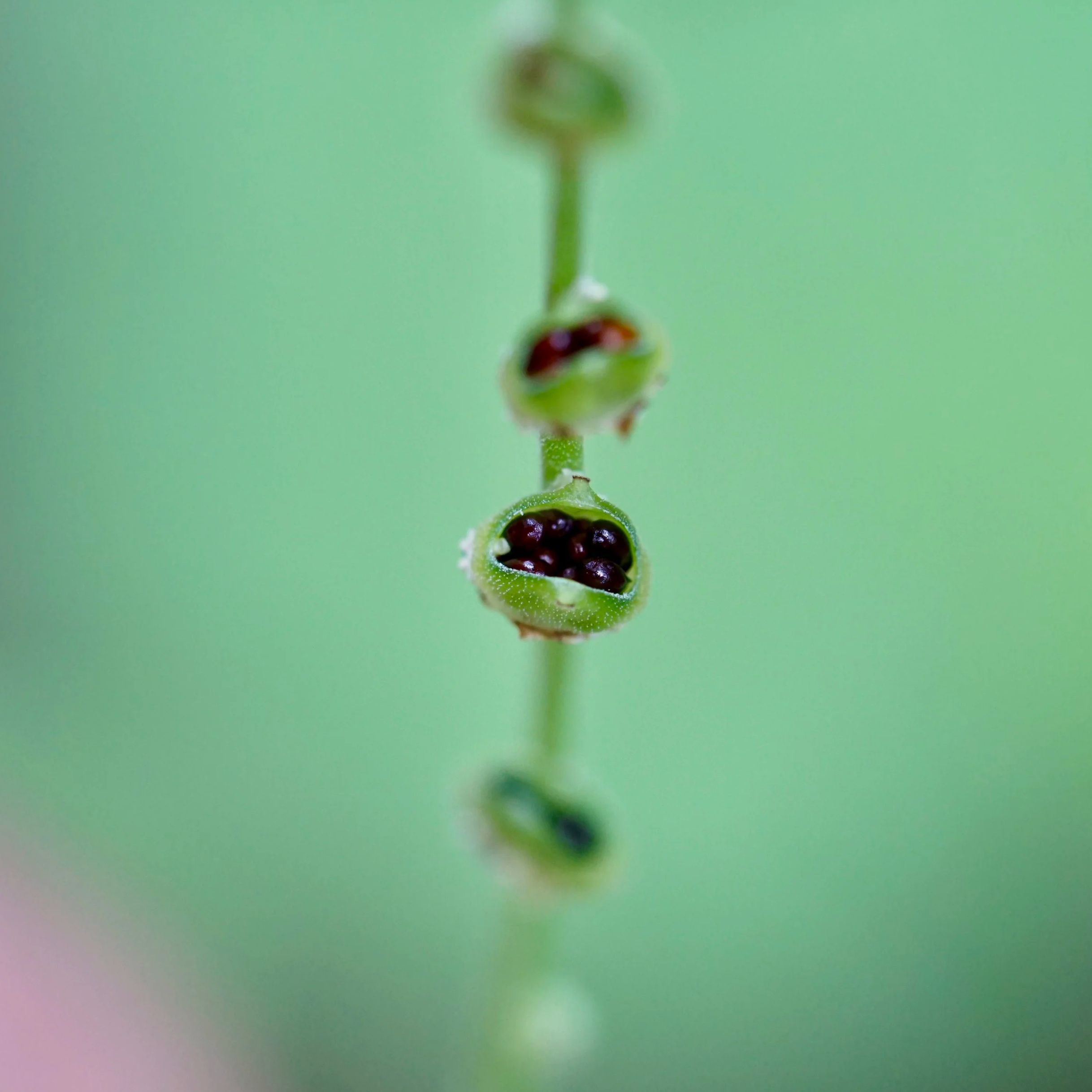
Fruits of Mitella diphylla.
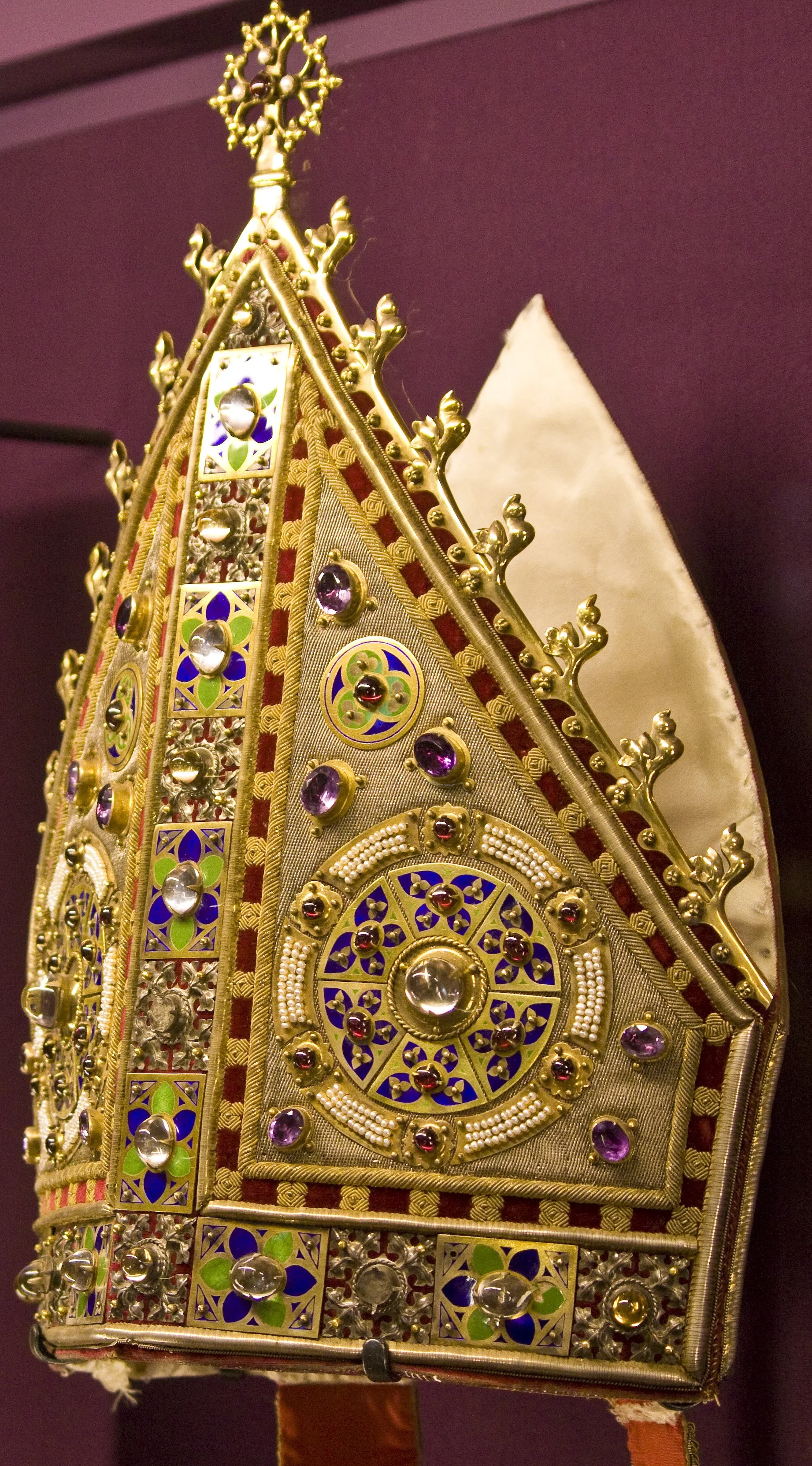
An actual mitre resembling Mitella fruit. Photo credit: “Gothic Glory II - Mitre” Lawrence OP, CC BY-NC-ND 2.0
At Fulham Palace, there is a large wooden sculpture nestled up near a leatherleaf viburnum (Viburnum rhytidophyllum). The sculpture depicts another Bishop, Mandell Creighton. Atop his head is a mitre, or bishop’s cap. This reminded me of the herb native to North America, that bears the same name: Bishop’s cap. Its scientific name, Mitella diphylla, was christened by Carl Linnaeus because he thought the fruit resembled a mitre. The resemblance is striking, but in my opinion what is more striking about the plant is its flower - which bears petals that are as dissected as snowflakes.
In April, I led a botanizing walk on the 76th annual Spring Wildflower Pilgrimage in the Great Smoky Mountains National Park. We caught the Bishop's cap in full bloom, a true spectacle. Some plants were already displaying their namesake fruits, but I was transfixed by the petals. In this essay I will explore why these odd flowers look the way they do and their evolutionary implications.
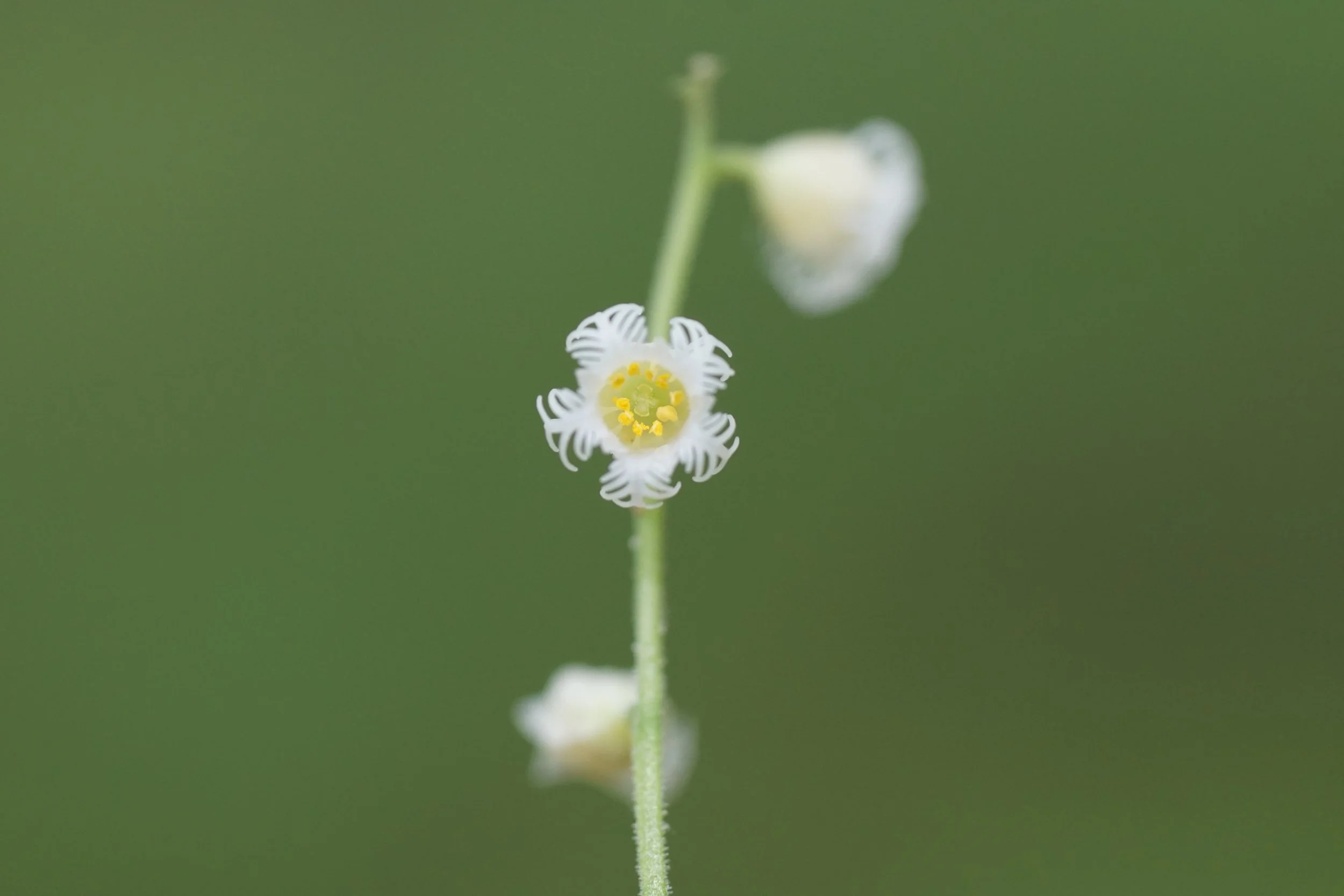
Flowers of Mitella diphylla with frilly, dissected petals.
I would like to start at the beginning, the very beginning. The world once existed without petals. Before ~150 million years ago, conifers flexed their cones to release seeds and ferns hurled their spores into the wind, but no flowering plants existed. It was only during the Cretaceous Period when the first flowers evolved. The exact timing of just about anything at the paleontological scale often has a huge error bar - less than 10 million years would be considered quite accurate. The first fossils of any group will only ever give us the minimum age of that lineage. This is because fossilization and long-term preservation are rare and excavation is difficult. Even when fossils are unearthed, what are the odds that they represent the exact first forms of the newly evolved organism? Unlikely.
Among the oldest macrofossils confidently assigned to flowering plants is ~124.6 million years old. This odd plant is called Archaefructus, discovered in northeastern China. The plant is somewhat inconspicuous. Its sparse thin stem is flanked by alternating lacy leaves that are highly dissected. Crowned atop this scraggly stem is a loose arrangement of lateral structures that resemble small angular bean pods. At the base there are several pollen producing structures, which mature first, disperse their pollen, and fall off. Above this cluster are the seed-producing structures, the carpels, which mature into fruits. These flowers, or inflorescences (their exact structure is still contested), lack petals. They are stripped down to their essential reproductive parts, or more accurately never even evolved the other bits to start with.
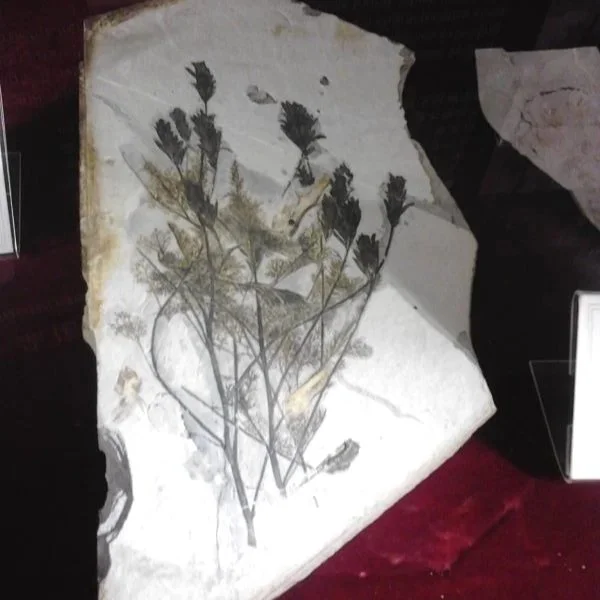
Fossil of Archaefructus sinensis. Photo credit: EddieZhang0128, CC BY-SA 4.0
The fact that the world’s first flowering plants did not have petals should not be terribly surprising upon reflection. If flowering plants evolved from organisms that originally lacked flowers, what exactly would we expect the transitory form of their reproductive structures to be? When we start to pull at this thread several more questions unravel. If flowering plants evolved from plants without flowers, what exactly was this intermediate structure between seed plants and flowering plants? What even is a flower and what does it mean to be a flowering plant? Where do we draw the line between seed plants and flowering plants? If all the lineages of plants between seed plants and flowering plants were alive today, would we be able to draw a line between conifers and flowering plants? At what point is a plant a flowering plant or a seed plant? Extinction has helped with this classification, it has pruned all of the lineages that may show an intermediate form between pine trees and magnolias. But, Archaefructus tests our limits.
I apologize, but I will leave most of these questions unanswered; their full account would take us too far down this interlude. I will, however, answer one. What defines a flowering plant is not actually the flowers themselves, but fruits. The fruit is derived from the seed-bearing part of the flower called the carpel. Across the many living plants, fruits have become highly elaborate, but in their simplest form fruits are just bits of plant tissue surrounding and protecting the developing seeds. So, while Archaefructus lacks traditional flower-looking flowers, they do have bona fide fruits. Their fruits are a bit difficult to visualize, but imagine a leaf folded lengthwise (like a hotdog bun) with seeds lined on the inside - sort of like a green bean pod. This may have been what the earliest fruits looked like.
Petals arose much later in flowering plant evolution. The origin of these organs - thought to evolve from modified leaves in some cases - are clearly an adaptation to entice and attract animal pollinators. Indeed, from the gardener to the school child, we often associate petals with attraction. Petal diversity is, in part, what makes the flowering plants so impressive and diverse. Their number, color, arrangement, and size all interact to produce displays that vary considerably across the over 300,000 angiosperm species. But not all petals have evolved elaborate forms for visual attraction. The Bishop’s cap’s lace-wing petals show us otherwise.
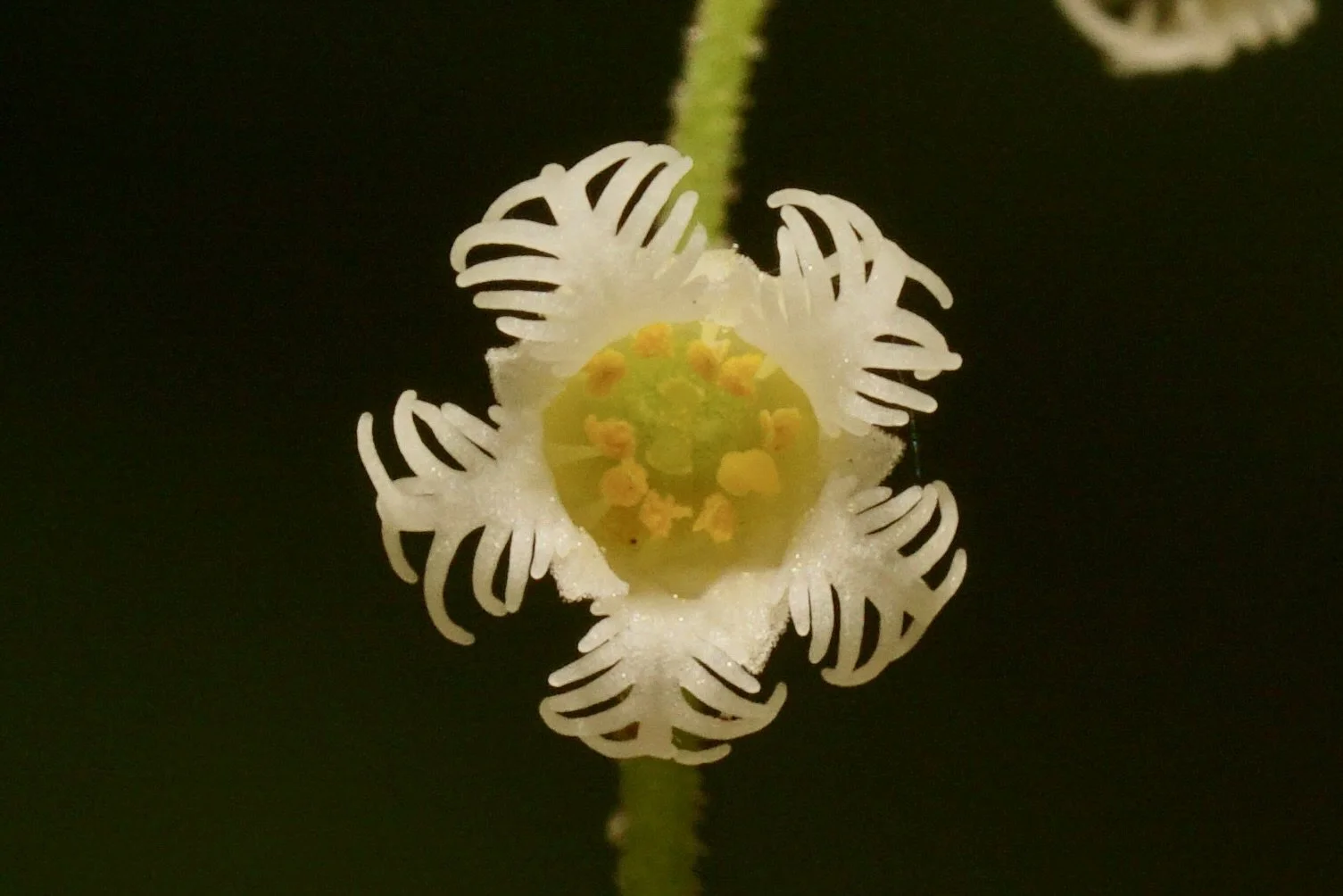
Flower of Mitella diphylla.
I was first introduced to the beautiful flowers of Mitella diphylla in a PowerPoint slide for a plant diversity course at Harvard. I was struck by their their petals. The beautiful five white structures look more like snowflakes than plant organs. When I finally saw them in the parenchyma (plant flesh), I am sad to say that I was initially underwhelmed. The projector made them appear so much larger than their actual 2mm size. However, after pulling out my hand lens and observing them at 10X magnification, the fascination returned. The detail of each petal was even more complex than the pixels projected. Less like snowflakes, and more like fishbones, with around several pairs of ribs carefully expanded along a central spine.
As I would do for many other flowers, I initially assumed that these showy petals are adaptations for attracting pollinators. But, which pollinators? How could such miniscule petals serve as a visual attractant in such a vast and complex landscape as the temperate forest? Who is Mitella attracting, how is it attracting them, and why did these petals evolve?
There are two types of questions we often ask in biology: how and why? “How” questions are often easier to answer. For instance, to understand how Mitella produces dissected petals, we could track petals as they develop and actually look at them under a microscope. They may undergo differential rates of growth, whereby the cells in the petal “ribs” divide and expand more than the zones in the furrows. Or they may undergo programmed cell death, whereby cells in the zones between the petal-ribs die early on in development. The “why” questions are a bit more challenging. Why questions are inherently evolutionary ones. When we seek to ask why petals in Mitella evolved such deep dissection, what we are really asking is, how do dissected petals affect fitness relative to non-dissected petals, and what is driving this evolutionary change?
Fitness in the natural world is not about strength or size, but all about survival and reproduction. If an organism reproduces more, and more of their offspring survive to maturity, that organism is said to be fitter. So, if we truly want to know “why” petals evolved to look like snowflakes, we would ideally need to be immortal, have a time machine, and have a lot of help counting. We would need to travel back to a time when ancestral populations were variable for the individual trait of petal dissection. In the past, some plants would have had more strap-shaped petals and others would have had more dissected petals - a mixed population of ancestral pseudo-bishop’s caps. We would then want to quantify the number of offspring (fruits and seeds) each individual type of flower produced and the survival of all of those individuals over time. This latter part is important because initial survival and reproduction does not necessarily indicate future survival of those offspring. We would then need to observe the “driver” of petal evolution - likely observing which pollinator is most effective at increasing fruit and seed yield over time. While this is the type of experiment scientists can conduct on short-lived, fast-reproducing organisms like yeast or bacteria, it is untenable in long lived organisms.
The next best thing is to set up experiments to manipulate petals and ask how this affects fruit and seed development. This is exactly what Katsuhara and colleagues did in 2017. As part of a research project they designed an elegant experiment to test the functionality of these highly dissected miniature petals. Using a Japanese relative of Bishop’s cap, Mitella pauciflora, they set up an experiment where petals of different plants were manipulated into three treatments: 1. a control where petals were not manipulated at all, 2. a partial petal removal, where the tips of petals were clipped from the flower, and 3. a complete removal of petals. The team then set up camera traps to observe visitation behavior of its pollinators.
What the team found was fascinating. Apparently, members of the genus are pollinated by fungus gnats and are attracted to the flowers primarily by chemical cues such as linalool and β-caryophyllene, and nectar. Shockingly, their petals don’t actually serve as direct attractants for their pollinators. They deduced this from the observation that rates of flower visitation from gnats did not change when petals were removed or cut. Rather, the petals act more as a landing pad for the gnats, where they can grab onto the petal crevices. Surgical manipulation decreased the probability of successful gnat landing by roughly 30%, relative to normal uncut petals. Snipping petals also decreased fruit production. If we assume that fruit and seed set directly correlates to a plant’s long-term fitness (this is a major assumption in evolutionary biology), it means that Mitella petals increase the fitness of individuals, not by attracting more gnats, but by assisting them in physical landing on the flowers. In this way, we could say that fungus gnat landing patterns may have driven the evolution of petal morphology in Mitella by selecting for more dissected petals, which increased landing probability and fruit set.
A structure originally evolved for one function can be co-opted for another. A walk around the gardens at Fulham Palace would likely give us the impression that petals evolved to attract - both pollinators and our own gaze alike. The tiny flowers of Mitella tell us otherwise. Their flowers are not successful because they attract pollinators from a distance, but by offering a foothold to their miniscule pollinating gnats. From the naked carpels of Archaefructus, to the deceptive form of bee Orchids, and the wind-borne pollen in oak catkins, evolution has created countless ways to be a flower.
Further readings and references:
Gomez, Bernard, et al. "Montsechia, an ancient aquatic angiosperm." Proceedings of the National Academy of Sciences 112.35 (2015): 10985-10988.
Gravendyck, Julia, et al. "Barremian tricolpate pollen from Portugal—New evidence for the age of eudicot-related angiosperms." Proceedings of the National Academy of Sciences 122.21 (2025): e2421470122.
Katsuhara, et al. 2017. "Functional significance of petals as landing sites in fungus‐gnat pollinated flowers of Mitella pauciflora (Saxifragaceae)." Functional Ecology.
Morris, Sandra. "Legacy of a Bishop (Part 2): The Flowers of Fulham Palace Gardens Introduced 1675-1713." Garden History (1993): 14-23.
Okamoto, T., et al. "Parallel chemical switches underlying pollinator isolation in Asian Mitella." Journal of Evolutionary Biology 28.3 (2015): 590-600.
Okuyama, Yudai, Makoto Kato, and Noriaki Murakami. "Pollination by fungus gnats in four species of the genus Mitella (Saxifragaceae)." Botanical Journal of the Linnean Society 144.4 (2004): 449-460.
Sun, Ge, et al. "In search of the first flower: a Jurassic angiosperm, Archaefructus, from northeast China." Science 282.5394 (1998): 1692-1695.
Wulf, Andrea. The Brother Gardeners: A Generation of Gentlemen Naturalists and the Birth of an Obsession. Vintage, 2010.
Edited by Ben Goulet-Scott