

The False Calyx of Mirabilis
Open up any botany textbook or Google any flower diagram and you’ll see the same basic structure of four floral parts. These parts can be thought of as successive whorls. In the simplest terms, the innermost whorl is the seed-producing structure (called the gynoecium), composed of the stigma where pollen lands, the style that holds up the stigma, and the carpel where the seeds are produced. Just outside of that is the androecium, composed of stamens (pollen-producing structures). Then come the petals, collectively called the corolla. Last but not least is the outermost floral whorl, the sepals, collectively called the calyx. The calyx is usually the least “flower-looking” part. It protects the developing flower in bud and, if it persists at all, is usually a whorl of green leaf-like appendages at the base of the flower.
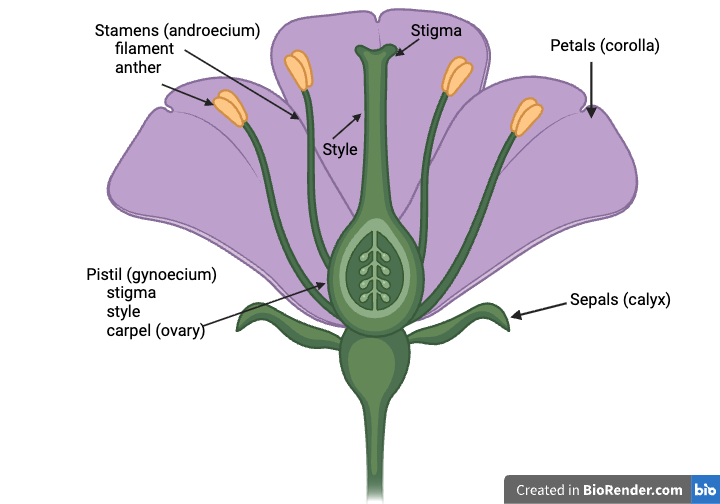
Floral diagram showing the distinct parts of a flower.
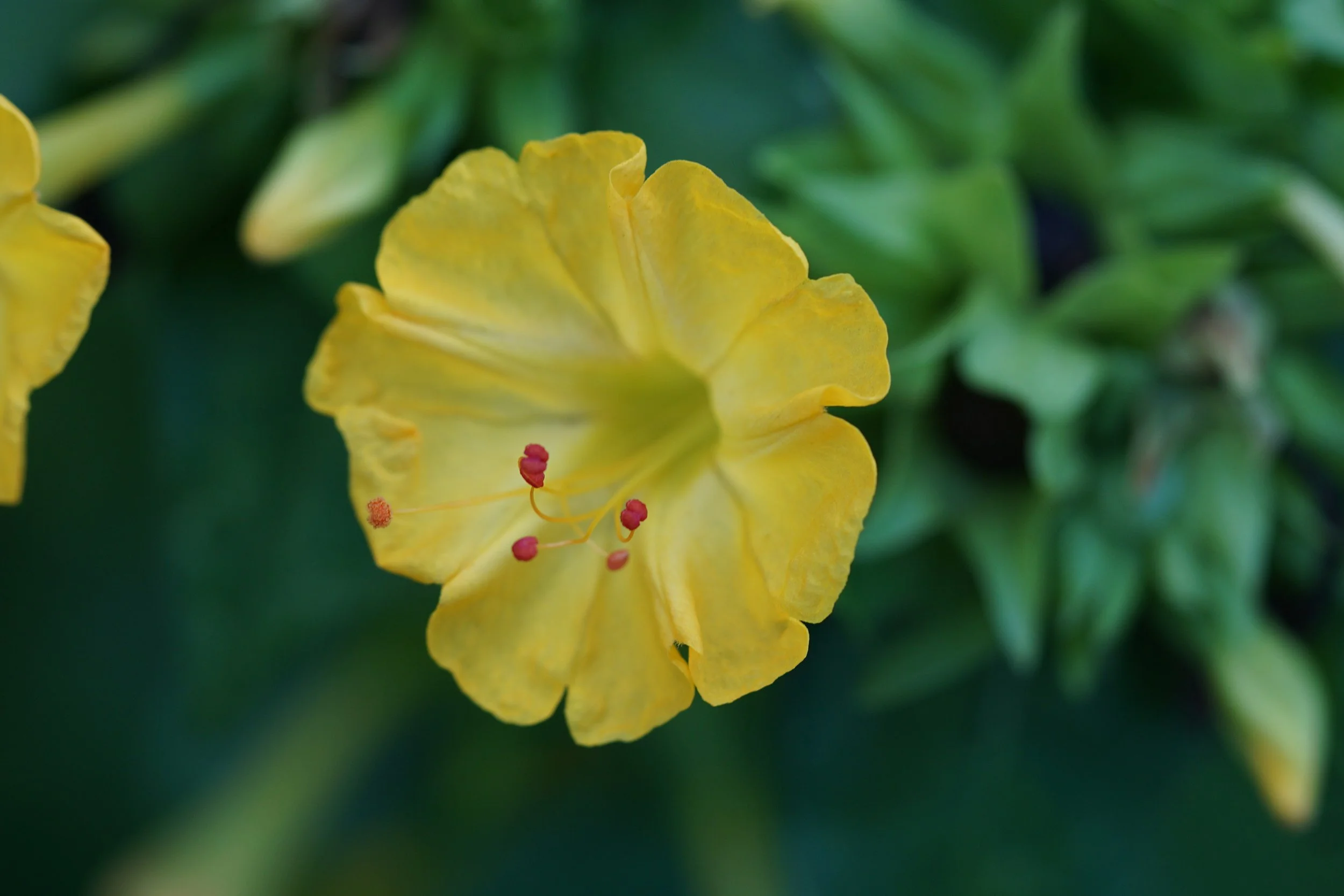
Based on Valpy’s etymological dictionary of Latin (1828), the word calyx is derived from the Greek κάλυξ, meaning a husk or pod. After diving down a Wiktionary etymology rabbit hole it becomes apparent that κάλυξ itself may be derived from καλύπτω, which means to cover or conceal. I find this definition quite fitting when it comes to understanding the calyx of one particular special plant: Mirabilis jalapa, the 4 o’clock plant (Nyctaginaceae, Caryophyllales).
The 4 o’clock plant has intricate biology to match its beauty. Mirabilis boasts a beautiful flower that includes a whorl of five fused petals, stamens, and a single-carpeled pistil, all subtended by five sepals that make up a beautiful green calyx. It grows natively from Mexico down to Peru and is widely cultivated around the world for its stunning floral displays.
When it comes to common names, most relate to a plant’s use for humans, its appearance, or its place of origin. Few plants are named for their circadian cycles. The odd common name of the 4 o’clock plant refers to its unique timing of anthesis (floral opening). A singular flower of M. jalapa only opens up once, and that starts at around 4pm. Each flower will remain open all night, until the following morning at ~8am. It is, in some capacity, crepuscular as well as nocturnal. This is a bit odd. Most plants will either flower during the day (diurnal), at night (nocturnal), or at dusk and dawn (crepuscular). This is because the distinct classes of pollinators are active at these different times of day and animal-pollinated flowering plants have often evolved adaptations to particular groups of organisms. For instance, nocturnally flowering plants are usually pollinated by night flying noctuid moths, beetles, or bats. Daytime flowering plants are usually pollinated by bees, birds, butterflies, and the like. What about Mirabilis, is it specialized for some unique pollinator?
Stories of plant pollinators are often ones of specialization. Some of the most iconic are the specialized bee-mimicking orchids (Ophrys), fig wasps completing their entire life cycle inside the fig (Ficus) inflorescence, or the most iconic Darwin orchid (Angraecum sesquipedale), with a nectar spur that can be upwards of 15 inches long and its pollinating moth, endowed with a proboscis of the same length. But, many flowers are just pollinated by whatever will visit them - not specialized for any specific animal visitor. The floral behavior of the 4 o’clock plant seems to be adapted for bet hedging rather than specialization. During the late afternoon when the flower opens, and in the morning just before the flower closes, it is pollinated by crepuscular bees and other insects. At night, the flowers seem to be pollinated by hawkmoths (for example, Hyles lineata). Opening during the day and night is its initial bet hedging strategy.
Generally speaking, outcrossing is better than inbreeding for sexually reproducing organisms because it increases the genetic diversity of their progeny. However, inbreeding (often called “selfing” in plants), is better than not having any progeny at all. Generally speaking, outcrossing and selfing plants tend to have a different ratio in the number of pollen grains and ovules (seeds) they produce. If the pollen:ovule ratio is high (several hundred or thousands of pollen to one ovule), the plant is likely outcrossing, meaning it needs pollen from another individual to fertilize its seeds. On the other hand, if the pollen to ovule ratio is low (dozens of grains to one ovule), it suggests that the plant is able to inbreed, or self-pollinate. The reason for this is specificity. In outcrossing plants, the likelihood of any pollen grain landing on the stigma of another flower is low, so making many more pollen grains relative to ovules is reproductively prudent. It is much more likely for a pollen grain to land on a stigma within a singular flower of a selfing plant, so lower the ratio. According to research from Cruden in 1973, M. jalapa has roughly 300 pollen grains for every one ovule. This would suggest it is an outcrosser - albeit on the slightly lower end of outcrossing ratios, which may exceed several thousand to 1 in outcrossing wind-pollinated species like oaks or chestnuts. However, when botanizing these plants, you will notice that essentially every single fruit develops. This would be unusual in an outcrossing system. Usually, some fruits will not receive pollen and will thus abort or never develop. It turns out that the 4 o’clock plant has a backup plan for ensuring fertilization, and it has evolved an intricate mechanism to do so.
As the flower opens, the stigma is exserted well beyond the anthers, meaning the pollen of the same flower is less likely to fall on its own stigma. When it’s time to close, the flower does not simply senesce and fall off, but does a striking dance of death. As the flower closes, the stigma curls backwards into the floral tube. As it does so, it gently kisses the stamens, leading to self-pollination. After that, the petal lip folds in on itself, bringing the stigma and anthers even closer together, facilitating additional self-pollination. If that whole dance was not enough, the petal tube then rolls inwards on itself before it finally dies back. That is a lot of movement for a dying structure. The entire mechanism of anthesis in Mirabilis is hypothesized to ensure that each flower first has the possibility of outcrossing during the evening, night, and early morning; then, if all else fails, each seed is self-fertilized by the morning.
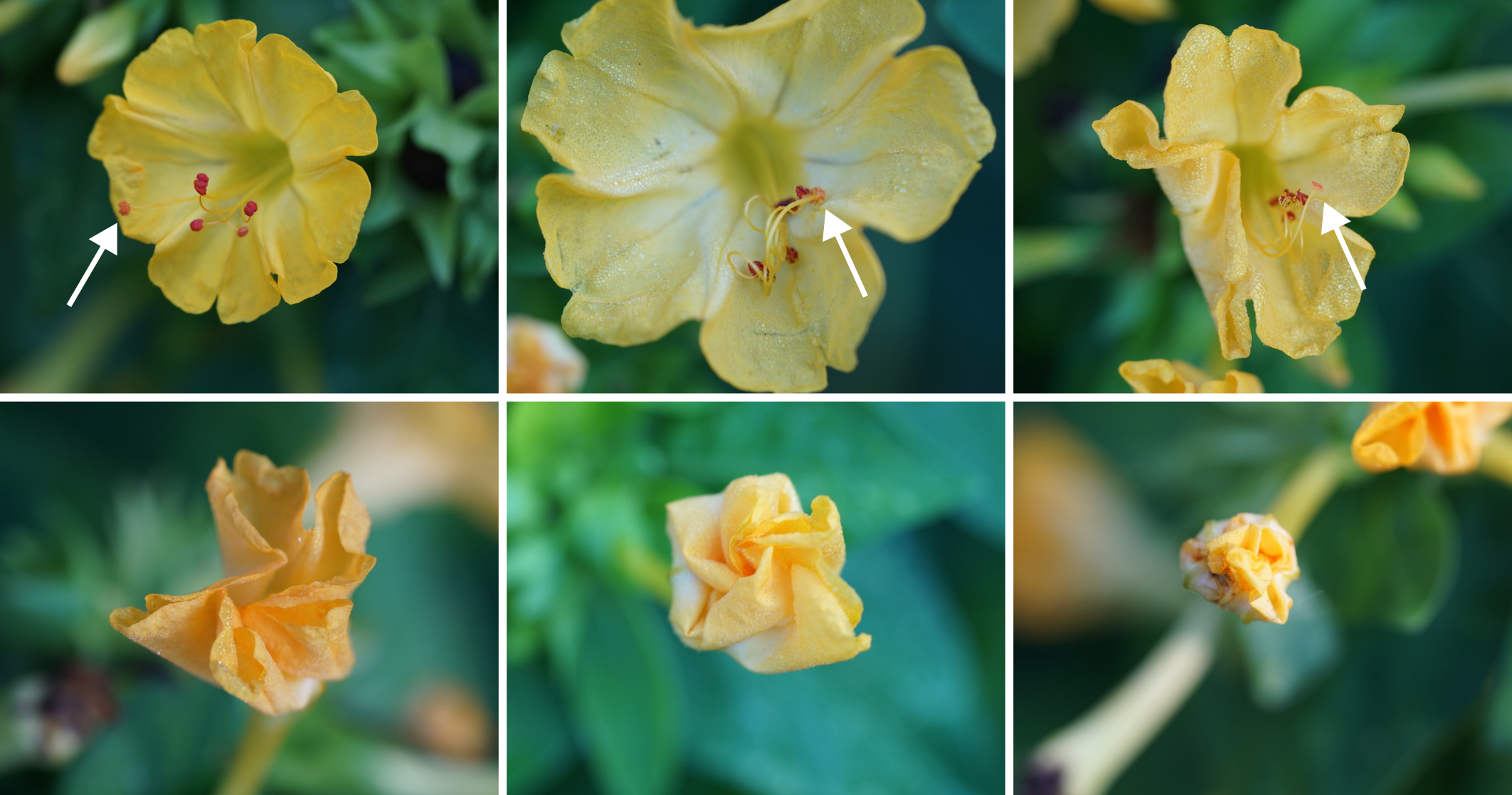
Developmental sequence of floral tube closure. This is meant to be read from left to right and top to bottom. Upper left image showing open flower at roughly 4’oclock. The stigma is exserted beyond the stamens. In the early morning the stigma and stamen start to roll in on themselves, touching in the process. As the flower senesces throughout the morning, the petals fold and then roll in on themselves. Arrows are pointing at the stigma across development.
I was not faithful in my articulation of the floral morphology of Mirabilis. It appears to have all of the right floral parts: calyx, petals, stamens, and gynoecium. But this is deceiving. The floral structures of Mirabilis are not what they seem. They are converged and repurposed structures, concealed in plain sight.
Mirabilis jalapa is a member of the Nyctaginaceae family, which is defined by having flowers that lack the two parts of a perianth (sepals and petals). Rather, the petaloid structures of nyctags are usually defined as a calyx. So, in Mirabilis, what looks like the petals is actually the calyx, which is petaloid and forms a large yellow tube. Likewise, most nyctags also have flowers that are subtended by a cluster of showy leaf-like structures called bracts (for example, the showy red bracts in the unrelated poinsettias at Christmas markets). Usually each flower is subtended by a single bract and there are several flowers per cluster, what we see in plants like Bougainvillea. In Mirabilis, what looks like the calyx, is actually a system of five bracts.
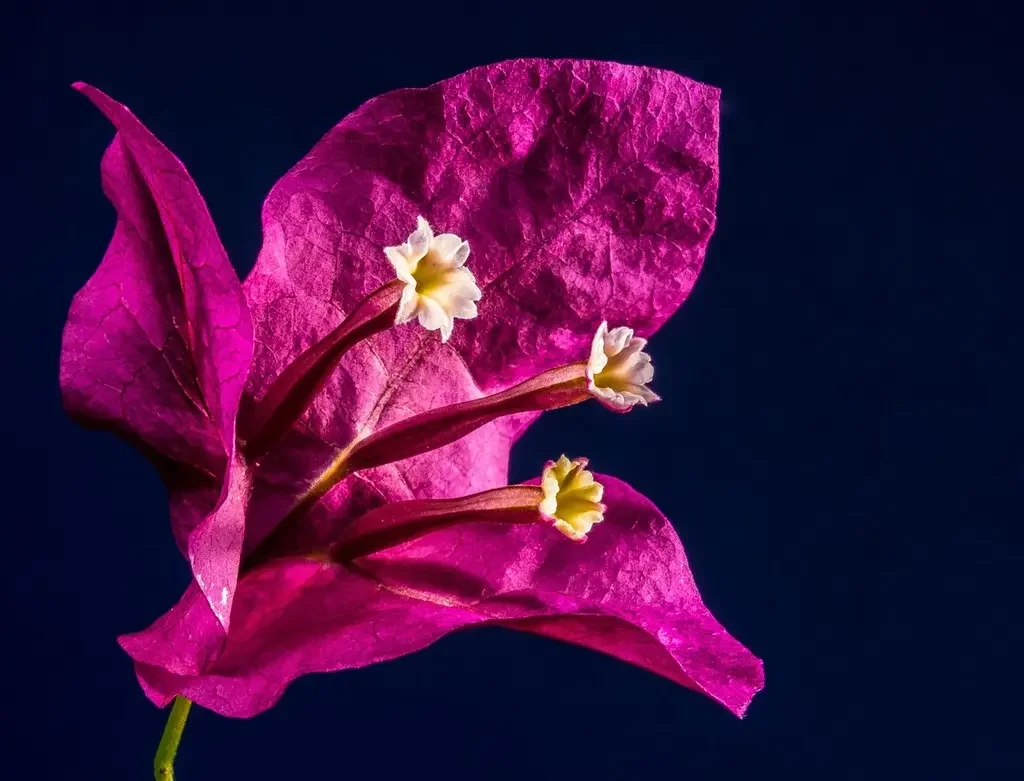
Inflorescence of Bougainvillea showing three flowers subtended by three pink bracts. Source: Pixabay Creative Commons CC0 1.0 Universal Public Domain
We can reconstruct this odd formation by looking at the evolutionary relationships between species in the genus Mirabilis. There are roughly 60 species in the genus, and some of them produce more than one flower per inflorescence. For instance, Mirabilis nyctaginea has a large five-parted fused set of bracts that resemble a calyx, but it actually subtends several flowers instead of one, while M. glabra has the same bract system with only two flowers. The ancestor of Mirabilis once possessed an entire inflorescence with multiple flowers - likely five since the calyx has five lobes. Over the evolutionary history of the genus, this group of five was reduced to a single flower per inflorescence, however the bracts remained a consistent number (5). So these five nice “sepals” are actually ancestrally modified bracts. All that is left is a single flower made up of a showy fused calyx, subtended by five individual bracts that are fused together into newly evolved false “sepals.” So, if we were to redefine the flower of Mirabilis we would say that it has five leafy green bracts that subtend the single-flowered inflorescence, and the showy bit of the flower is actually a petal-like calyx tube with no true petals.
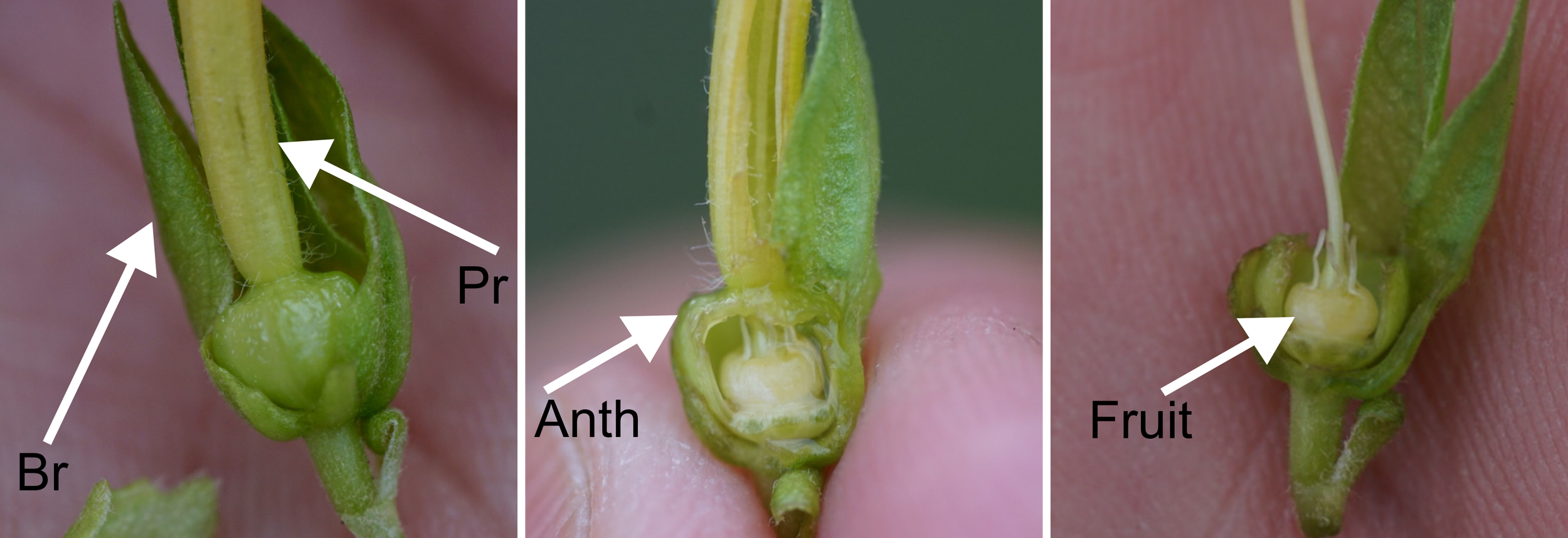
Diagram denoting how the “fruit” wall is actually just the extension of the petaloid calyx. Outer green structures are the subtending bracts (Br), not the calyx. The floral tube - composed of the true calyx (Pr) fuses around the developing fruit, developing into the anthocarp (Anth). The filaments of the stamen (white string-like bits) are attached inner to the anthocarp, but outer to the fruit. The immature fruit (Fruit) sits inside of the calyx-derived anthocarp.
There is one more odd thing about Mirabilis: its supposed “fruit.” The fruit section of the market exemplifies our colloquial use of the term fruit. But, a fruit is much more than a sweet fleshy berry. Botanically, a fruit is simply the matured ovary of the plant, a structure that is made up of parent tissue and houses the seeds. It is hard to find a good analogy because plants are so different from animals, but the fruit could be analogized to the amniotic sac of humans and other mammals. From an evolutionary perspective, a fruit is simply just a leaf folded longitudinally around several seeds - think of a split open green bean.
In Mirabilis, the fruit is a single-seeded structure - like a tiny avocado without the flesh. If you look carefully at the developing flower and fruit, you will notice that the floral tube (the true calyx) wraps itself around the actual fruit, which is a thin-walled light brown structure inside. As pollination ensues and the fruit develops, the calyx tube becomes black and hardened off, turning into what appears to be the fruit. This is not the fruit, but an additional layer of maternal protection around the fruit, called the anthocarp. The placement of the stamens also shows us how the outer layer is not the fruit at all, but calyx. If you look closely you will see small white strings sitting inside of the false fruit structure, but outside of the inner fruit structure. Those strings are the base of the stamens (called the filament). Based on the traditional floral diagram, we know that stamens are always produced inner to the petals and calyx. So it is developmentally impossible for the outer structure to be the actual fruit. It must be the continuation of the calyx tube. Why does it wrap its fruit up with more tissue? Well, the idea here is quite simple. The anthocarp is likely providing an additional layer of protection around the fruit itself. Wrapping the true fruit with more maternal tissue actually happens many times across flowering plants. For instance, chestnuts, hop hornbeam, and roses all have their fruits wrapped up in more maternal tissue. Each time this additional layer has developed in a different way.
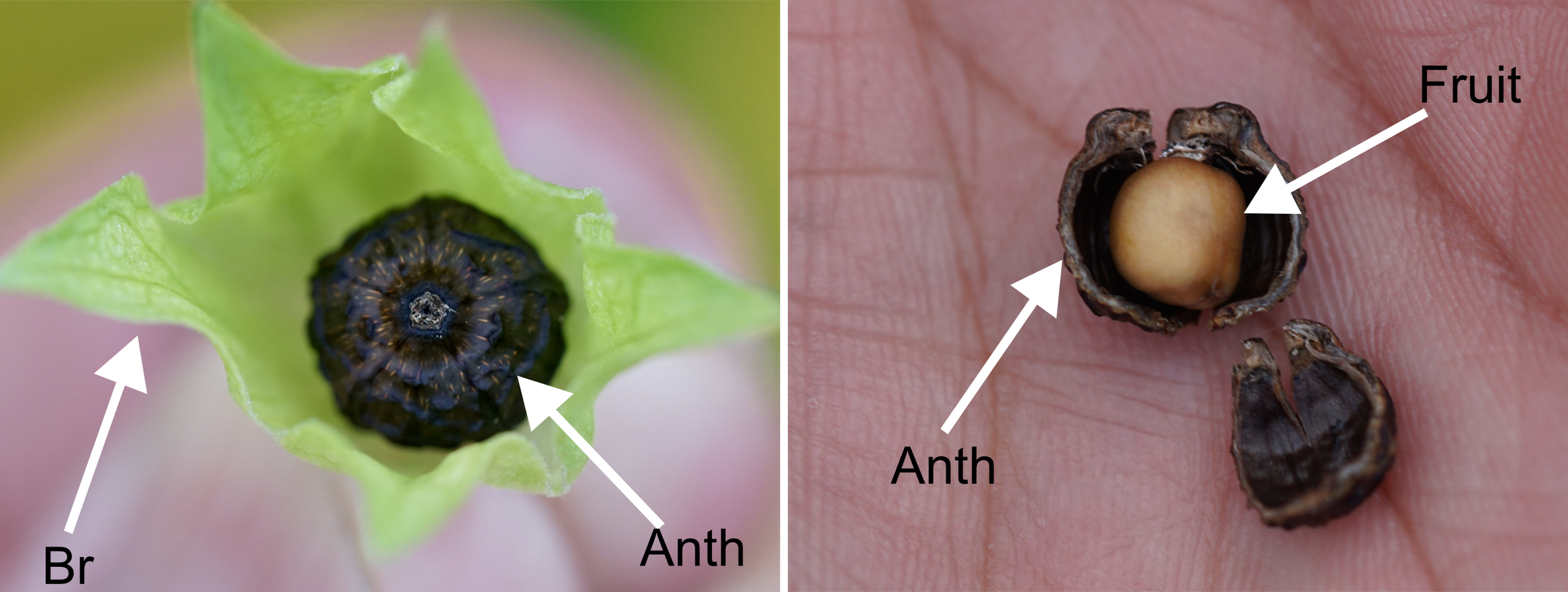
False fruit of M. jalapa. The outer green structures are the bracts (br). The dark fruit-like structure is the anthocarp (Anth) and the inner seed-looking structure is the actual fruit (Fruit). The fruit is a single-seeded, thin-walled structure.
How does this develop and what does this tell us about selection pressures and how evolution occurs? This is a fascinating example of repurposing and convergence through completely separate means. In the evolutionary history of Mirabilis, somewhere along the line they lost the ability to produce both sepals and petals, and only produced one whorl of sepaloid structures. In Mirabilis it seems as though the “calyx” was functionally re-evolved by tinkering with what was already present in the lineage: bracts. It would be almost impossible to determine the exact origin of these structures if it were not for evolutionary analyses and comparative development. The insights of the 4 o'clock plant could only be revealed by looking at its relatives.
How many other flowers in the botanical world develop like this, or in other similar, yet deceiving ways? The Nyctaginaceae has a nice gradient in floral characters across species, providing us with the evolutionary clues into the origin of the 4 o’clock plant’s odd flower. But if extinction eliminated many of these lineages, it may have also removed these clues. There are likely myriad structures across plant biodiversity which have converged on identical structures through entirely unique processes that we cannot perceive because lineages with related forms do not survive.
The interesting point is not just convergent evolution, this happens all the time. The hallmark of convergence is the evolution of the same type of structure in completely different organisms that are not closely related. Understanding the distant relationship allows us to infer that the structures must have evolved independently (e.g., wings in birds and bats). The context for surprise in this case is that the entire group of 300,000+ flowering plants (including Nyctaginaceae) all evolved flowers with “normal” fruits, sepals, and petals. So, when we see a flower within a group that appears to have the standard set of flower parts, it is most parsimonious to assume that it is a shared trait. But that is not the case for Mirabilis. This would be like if, within birds, one lineage lost wings, and then re-evolved wings independently by modifying the rib cage. Upon initial observation it would seem like the wings are the same as any other bird wings, but careful developmental analyses may show otherwise.
The works of nature can sometimes καλύπτω (conceal) the truth. Only when we peer under the evolutionary hood can we uncover how structures came to be.
Further readings and references:
Brockington et al. International Journal of Plant Sciences (2009)
“Calyx.” Merriam-Webster.com Dictionary, Merriam-Webster, https://www.merriam-webster.com/dictionary/calyx. Accessed 20 Jul. 2026.
Cruden, Robert William. "Reproductive biology of weedy and cultivated Mirabilis (Nyctaginaceae)." American Journal of Botany 60.8 (1973): 802-809
Ewusie, J. Yanney, and E. C. Quaye. "Diurnal periodicity in some common flowers." New Phytologist 78.2 (1977): 479-485.
Hodges, Scott A. "The influence of nectar production on hawkmoth behavior, self pollination, and seed production in Mirabilis multiflora (Nyctaginaceae)." American Journal of Botany 82.2 (1995): 197-204.
Hofmann, Ursula. "Flower morphology and ontogeny." Caryophyllales: evolution and systematics. Berlin, Heidelberg: Springer Berlin Heidelberg, 1994. 123-166.
Sattler, Rolf, and Louise Perlin. "Floral development of Bougainvillea spectabilis Willd., Boerhaavia diffusa L. and Mirabilis jalapa L.(Nyctaginaceae)." Botanical Journal of the Linnean Society 84.3 (1982): 161-182.
Sukhorukov, Alexander P., et al. "Anatomical diversity and evolution of the anthocarp in Nyctaginaceae." Botanical journal of the linnean society 196.1 (2021): 21-52.
Valpy, Francis Edward Jackson. An etymological dictionary of the Latin language. AJ Valpy, Baldwin and Company, 1828.
Vanvinckenroye, P., et al. "A comparative floral developmental study in Pisonia, Bougainvillea and Mirabilis (Nyctaginaceae) with special emphasis on the gynoecium and floral nectaries." Bulletin du Jardin botanique national de Belgique/Bulletin van de Nationale Plantentuin van Belgie (1993): 69-96.
Willson, James, and Richard Spellenberg. "Observations on anthocarp anatomy in the subtribe Mirabilinae (Nyctaginaceae)." Madrono 24.2 (1977): 104-111.
Edited by Ben Goulet-Scott